Thank you so very much for all your continued support!!!
Your support means so, so, so much especially for someone like me who is engaged in the most indie art of pretty much all the indie things!!!
I am sorry that I have long neglected it, but now I feel obliged to record the next episode as it seems like a lot of people are actually listening to it without my knowledge!
If you still haven’t listened to this rather short and sweet (& rough-cut) podcast, you can find it on Apple Podcasts, Spotify, and YouTube.
One of the most famous landmarks in Japan is Kaminarimon(雷門; かみなりもん) or the “Thunder Gate” in Asakusa, Tokyo.
Along with Mt. Fuji, Tokyo Skytree, and Tokyo Tower, it is no exaggeration to say that it is recognised by virtually all Japanese people.
But did you know that “Kaminarimon” (Thunder Gate) is just a nickname for this gate?
Many Japanese do not even know this, but its real name is “Furaijinmon” (風雷神門; ふうらいじんもん) or “The Gate of the Gods of Wind and Thunder”.
If you look closely at the picture above, you’d probably notice that there are two deities displayed on the sides of the gate.
The one on the left with the drums is Raijin (雷神 らいじん) or the god of thunder. He makes thunder with those drums.
I remember as a child I was told to hide my belly button as Raijin likes to eat it for whatever reason…
The one on the right is Fujin (風神 ふうじん) or the god of wind.
Therefore, the official name of Kaminarimon is Furaijinmon.
In fact, if you look at the giant red lantern from the other side, its official name is actually written on it.
Furaijinmon (風雷神門; ふうらいじんもん)
Asakusa is one of the destinations that I definitely recommend you to visit once the Corona crisis is over.
The remnants of the Edo period (1603-1867) can be still felt in this area, and it is widely considered the heart of the Edo culture. For rakugo lovers, it is also known as the home of Asakusa Engei Hall (浅草演芸ホール), one of the four full-time rakugo venues in Tokyo.
I am so looking forward to visiting Asakusa again myself!
I haven’t been thrilled this much for a while, and this is easily one of the highlights in my rather drab life.
I have REALLY been looking forward to this day for the following very good reasons:
The author is a big rakugo fan, and this book is her expression of her love for this art. She is even a fellow member of the English Rakugo Association!
I just found out that my master Kanariya Eiraku is the co-author of this book!!! (I just found this out myself… both Kristine and my master kept this a secret for a long time… cheeky them 😁)
I am featured in this book along with my rakugo superstars!
I can confidently say that it is the most accessible yet comprehensive book on rakugo that is available in the English language!
I forgot to mention, but the book even features some rakugo scripts by my master Eiraku!
The author has just notified me that she had ordered a copy for me to thank me for being a part of this book!
This year I’ve had an honour of working closely with a multi-talented artist, Fiona Amundsen.
About two months ago, our short film, which incorporates rakugo, the Aikido concept of “zanshin” (残心), and remembrance of WWII, was released on Asia New Zealand Foundation’s digital platforms.
This work was a part of “IN TOUCH arts commissions” by the foundation, and I feel very privileged to be a part of this project.
You can still view this film/ artwork, but before you watch it, I’d like you to know a few things:
My family’s experience in Nagasaki is only a personalised way of remembering our mistakes as humanity as a whole. I am deeply ashamed of what my Japanese ancestors did to many Asian nations and others, and this is no way our attempt to victimise Japanese.
It is our way of finding the universal message of peace in the ordinary, everyday things.
Part 1 is very dark and many may give up watching the rest, but Part 2 has some humour in it based on my own experience with my grandfather. But Part 2 only makes sense if you watch Part 1…
I decided to write this first because someone who probably hadn’t watched the work nor read the interview commented as below on the foundation’s SNS:
“Great idea! Let’s remember Nanking, Rangoon, Singapore, Jakaraka [sic], Port Moresby, and many many others too shall we?”
This work was created to do exactly that!
Here is the link to our work. You can also find our interviews on the page. Some of the super intellectual comments are by Fiona 😁
This is the year of defiance for the rakugo performers and fans, and these auspicious events are the proof that the pandemic simply can NOT stop us from having fun and sharing the joy of storytelling and laughter.
First of all, I would like to congratulate the author for her sense of humour, strength, and indomitable will to give birth to this influential work while residing in one of the countries that were affected by the pandemic the most.
I have had the privilege of being a friend with the author for the last few years.
She is one of the biggest rakugo nerds that I know 😁, and she has even become a member of English Rakugo Association! (Did I mention that even I haven’t joined yet?)
She has been a great promoter of this art in the English speaking world, and the world of “English Rakugo” is eternally indebted to her.
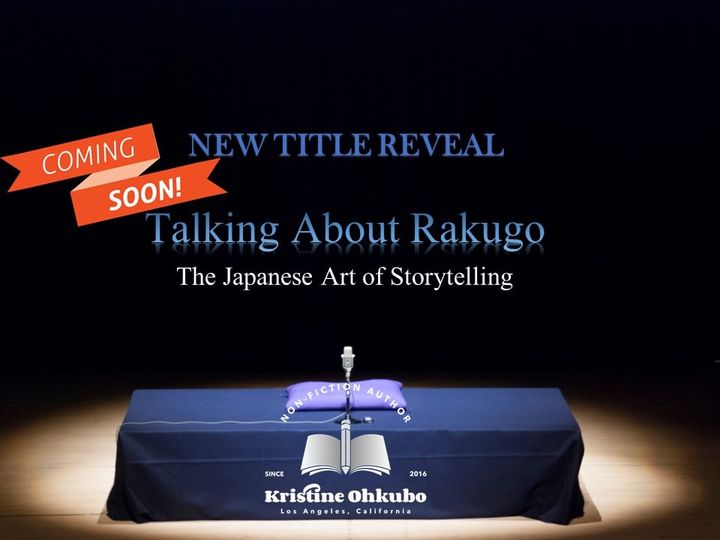
There have been some academic books on the subject of rakugo in English (that put me, a rakugo performer, to sleep!), but I can confidently say that “Talking About Rakugo: The Japanese Art of Storytelling” will be the first book of its kind in English language that is accessible to everybody.
This is the way it should be as rakugo is an art of the poor and the ordinary (like myself).
The author hasn’t announced the exact launch date, but you can follow her SNS to find out the date first:
To celebrate this special occasion, they are organising a free online performance/ workshop for children all over the world on Saturday 5 June 2021(American time). It will be held bilingually in English and Japanese 😃
I believe that the details will be posted on Rakugo Association of America’s Twitter and website, which is under construction.



 English Rakugo NZ