English Rakugo performer and actor based in NZ. A full-time rebel with common sense. A lover of art, books, comedy, Japanese culture/ language, music, peace, positivity, theatre, and trivia. Idealistic, but ain't no saint.
鹿鳴家英志(本名:中辻拓志)。ニュージーランドを拠点とする役者・英語落語パフォーマー。アメリカへの演劇留学をきっかけに、気付くと海外滞在20年。現在ニュージーランドに永住中。アメリカの4大卒業後は日本で英会話講師を経験、その後ニュージーランドの高校教師資格を取得する。ニュージーランドでは英語にてスタンダップコメディーを行い、2005年ニュージーランド国際コメディーフェスティバルの新人大会にて全国優勝を果たす。その後、テレビドラマ、CM等に出演、テレビのレポーターも勤める。
If you have ever visited Japan, you probably know that we are quite mellow people.
Those dead quiet trains make us look well-behaved and civilised.
Yet, when it comes to festivities, we go overboard andknow how to celebrate (not in the Latin American, Spanish, or Italian ways, but hey…).
Celebrations have kept Japanese civilisation going since time immemorial.
You may have heard of a festival called Onbashira Festival (御柱祭) where 16 fir trees (16-19 metre-long each) are pulled downhill by a group of people.
Every year, many people get injured and sometimes even die… but they still keep going regardless as festivals are crucial in Japanese life.
According to Kunio Yanagita (1875-1962), a renowned scholar and folklorist, all our activities can be divided into two categories: Ke (け; 褻) and Hare(はれ; 晴れ; 霽れ).
Ke refers to the ordinary.
Things or activities that you do every day like family life, work, school, etc.
Hare, on the other hand, refers to things and activities that are out of the ordinary such as festivals and rituals like wedding, coming of age, and Shichi-Go-San.
It is the balance between these two kinds of activities that have maintained Japanese life.
Even though many people assume that ke is from the word kegare (impurities), but this is not the case.
The concept of kegare was only added in the 1970’s to this hare-and-ke dichotomy.
Working hard on the ordinary (ke) and looking forward to the out-of-the-ordinary (hare) is how Japanese have coped with our rather stressful social life.
When I was interviewed by the author, Kristine Ohkubo, for the book, I thought to myself in a fake British upper-class accent:
“Oh, it’s so lovely she’s writing a book for rakugo newbies.” (* I don’t think the aristocrats use the word “newbies”… or “rakugo”.)
Oh my gush, I was so, so, so wrong!
This book is a gem full of rakugo knowledge. It is a one-stop-shop for rakugo newbies and connoisseurs alike!
The book opens with how rakugo began its journey and evolved into its present format. It introduces most of the legendary masters including Kokontei Shinsho V, Sanyutei Ensho VI, and Tatekawa Danshi V.
The truly unique feature of this book is that it covers such subjects as female rakugo performers, rakugo in other languages, and even Sign Language Rakugo!
But its biggest feature is that it includes 16 of my master’s rakugo scripts in English!!!
Now… let me sidetrack for a minute.
The author, Kristine Ohkubo, somehow managed to keep it a surprise for me that my master was actually her co-author until very recently!!!
So did my master Eiraku…
Now I know these two people are excellent at keeping secrets… something I had not known…
Getting back to the rakugo scripts, the following stories are included in this book, with which you can enjoy and/ or perform yourself:
Another Bottle of Sake (Kawarime)
The Summer Burglar (Natsu Doro)
Browsing in the Pleasure Quarter (Nikai Zomeki)
Faceless Ghost (Nopperabo)
The Father and Son Who Love Drinking (Oyako Zake)
Foxes in Oji (Oji no Kitsune)
Gonbei and the Racoon Dog (Gonbei Danuki)
Gonsuke’s Lantern (Gonsuke Jochin)
Okiku’s Dishes (Okiku no Sara)
Peach Boy (Momotaro)
Test Sake (Tameshi Zake)
Time Noodles (Toki Soba)
King Lear (Lear Oh)
The Replacement of Enma (Enma no Irekawari)
Scary Hamburgers (Hanbaga Kowai)
Japan Milk Corporation (Nihon Miruku Kosha)
Did I mention that the book also includes extensive interviews with English Rakugo superstars like Katsura Sunshine, Tatekawa Shinoharu, and my master Kanariya Eiraku?
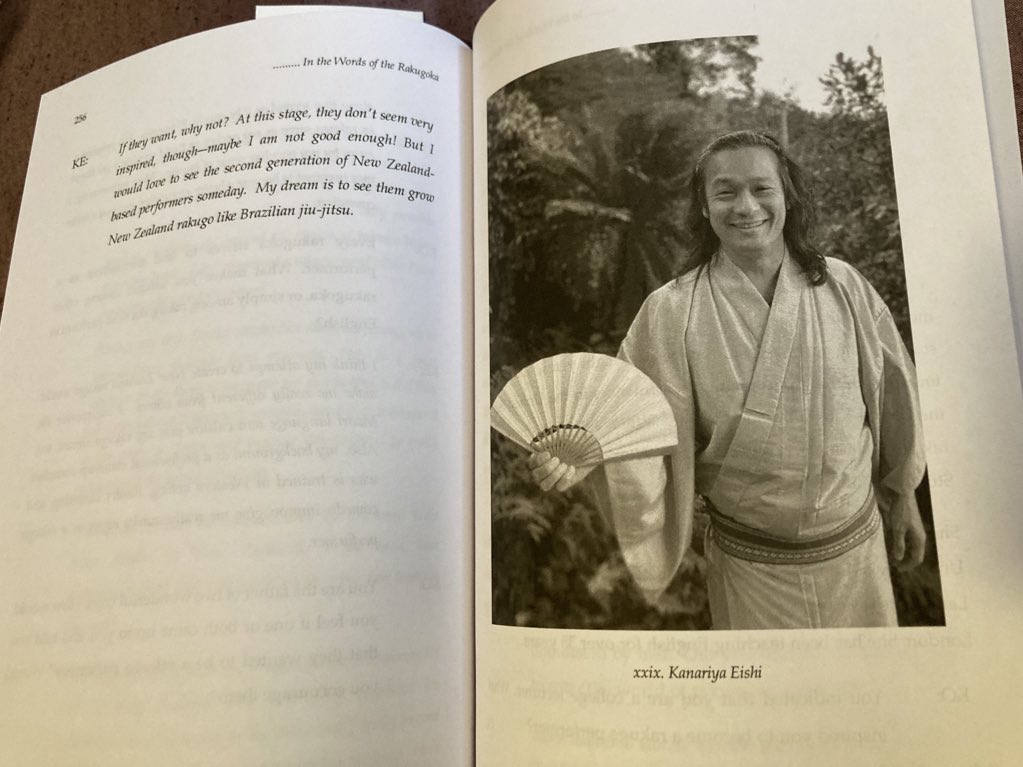
There is an interview of a lovely New Zealand-based performer called Kanariya Eishi, too.
Without any bias, I can confidently say that this is probably the best rakugo book that has ever been written in the English language.
I sincerely hope that this book will spread rakugo to the end of the world!
This is the beginning of a new chapter in English Rakugo.
Please read the entire article if you are planning to join Aoteya Rakugo Club.
Funding Approved!
The funding for Aoteya Rakugo Club has just been extended until December 2021!
I am really excited about this and extremely thankful for the Onehunga Community Centre for continuing their support for the club!
Thank you so very much, Auckland Council, for your continued support!!!
This Could Be Your Last Chance To Join Us
Before talking more about the club, I would like to inform that this could be your last opportunity to join the club.
At the end of last period, I (Eishi) had a heart-to-heart talk with the current members, and we agreed to go on until December and only continue after this period IF we double our active membership to around 10 by the end of the current period.
Our aim has always been to promote rakugo to as many people as possible, but if the current situation (only 5 active members) continues, I (Eishi) feel like it would be more effective for me to have more public weekend performances instead (unless the club becomes a hub for rakugo enthusiasts).
I really love the members and am very thankful for all the support we have received from the community, but I have come to this decision.
This is not a marketing tactics 😃, and if you want the club to keep going, please do join us now!
Kimono knowledge (there will be a field trip to a Japanese antique shop to purchase kimono; cheap ones cost less than $20)
Characterisation unique to this tradition
Storytelling in general (not only bound by rakugo)
Writing and/ or translating rakugo scripts
Japanese culture in general (and also learn from different cultures)
Location, Time, Dates, & Cost
Location
Maungakiekie Room, Onehunga Community Centre (83 Church Street, Onehunga)
* Enter from the main entrance of the building, turn right and go into the community centre, and go down the stairs right after the office=> In short, the room is located downstairs of the building!
Even though the purchase of the book is NOT required, it is highly recommended as it covers a lot of what is taught at the club, and it also includes 16 of my master’s rakugo scripts! I am introduced in the book, too. You can purchase the book from here.
One of the most traumatic experiences in my life was when I was asked to MC at my sister’s wedding.
Sure, it was a happy occasion, but my mind was constantly on the edge as I was not allowed to utter a single word that was not auspicious.
At a Japanese wedding, you cannot use words such as “break”, “end”, “separate”, or any expression that implies that the newly-formed relationship would not last… even if it is used in a completely different context.
At the end of a wedding, we cannot say “This is the end of the ceremony.” but instead we say “we open the ceremony.” (お開きにいたします。)
We have to be careful with the use of numbers as well.
Numbers 4 and 9 are considered unlucky in Japanese culture.
4 (四; Shi) rhymes with “death (死; Shi)”, and 9 (九; Ku) rhymes with “hardship” (苦; Ku).
Even numbers (2, 4, 6…) are considered less lucky compared to odd numbers (1, 3, 5…) as they can be split in half.
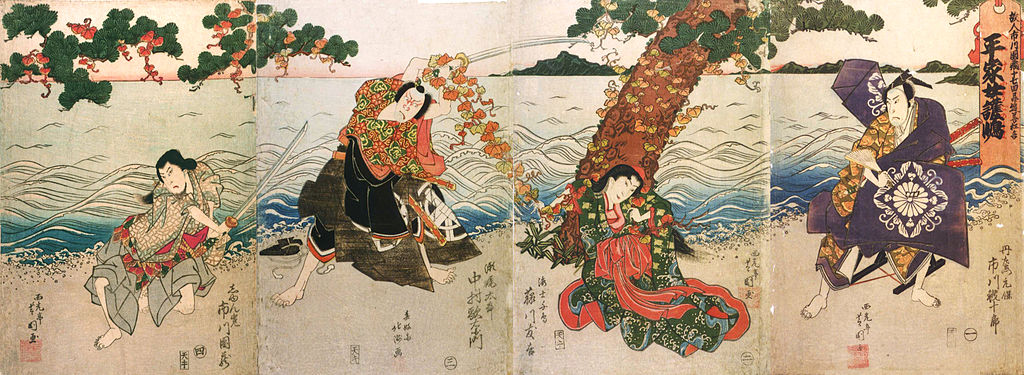
If you pay attention to the number of letters used in kabuki/ bunraku titles, nearly all of them are in odd numbers with a very few exceptions (here is the list of kabuki titles in Japanese if you are interested).
For example, the kabuki/ bunraku play “Hirakana Seisuiki” is written “ひらかな盛衰記” even though it would normally be written “平仮名盛衰記” as the former has 7 letters and the latter has 8.
They really made sure that the number of letters used are in an odd number.
Now…
Me being me, I did accidentally use a few inappropriate expressions at my sister’s wedding, but she is still with her childhood sweetheart, so really…
As I went through the entrance of the Christchurch Art Gallery, I was greeted by the gigantic picture of…
myself…
I was there for the opening of the “Things That Shape Us” exhibition that began yesterday on 24 July.
As those who know me will know, I am a very private person and do not always enjoy “publicity”.
I am aware that it is a necessary evil to keep doing what I love to do, which is to devote my life to rakugo until my very last breath, but it did make me feel a little uneasy and exposed if I’m to be honest.
But I was there to witness the story that my creative partner Fiona Amundsen and I wanted to tell through our work “An Ordinary Life”.
This work is based on actual and imaginary dialogues with my late grandfather, who was a witness of the bombing of Nagasaki.
Before I talk about this work, I’d like to be clear that it is NOT our attempt to victimise Japan or Japanese; I am deeply ashamed of our colonial past and what my ancestors did particularly to other Asian and Pacific nations.
It is our attempt to capture something universal, regardless of our race, nationality, belief, or religion, through my personal experience with my grandfather whom I deeply adored and respected.
It is a very personal account that is now open to the public.
My grandfather was an unconventional man for his generation.
He turned an artist (calligrapher/ shakuhachi, bamboo flute master), a teacher, a pacifist, and even a feminist after the war.
He was the funny grandpa who always made people laugh even in the toughest of circumstances.
He was a flamboyant man and…
a very bad driver.
He was an excellent liar, too.
He had hidden most of his experiences in Nagasaki where he lost his father and siblings.
Very, very well.
Painfully well.
Until his departure.
The inspiration for this work came when my mother told me about his journals on his deathbed.
They were full of darkness.
My mother destroyed all of the journals “to protect his honour”, and I was told what was written in there very selectively.
This made me want to know who this funny, cultured man really was.
I don’t even remember why, but Fiona and I talked about where my grandfather would be now before the opening.
My answer was, “He must be still on this side of the Sanzu River” (in the limbo state, somewhere between the worlds of the dead and the living, in the Japanese worldview).
At 4:00PM, all the artworks were blessed by karakia (Māori prayer).
Fiona said something like “Your grandfather is now blessed through karakia”.
I felt like my grandfather had finally moved on, but I was not too sure.
That night I was woken up in the middle of the night by a strange sensation as if some form of transformation was taking place.
Like a butterfly coming out of a cocoon.
Rebirth.
I was convinced that he had finally gone to the other side of the river and fallen asleep peacefully.
The next morning, I woke up to a text from my wife to tell me that our last remaining family member from the WWII generation had passed away.
Now all the family members who witnessed the war are gone.
A circle has been completed.
We must keep telling their stories on their behalf so that we will not repeat the same mistakes.
So that we will not lose our “ordinary life” that, after all, matters the most.
[This article turned out really long, so if you are interested in what the picture above is all about, please scroll straight down to the bottom.]
I recently watched a beautiful movie called “Ainu Mosir”, which is on Netflix and I thoroughly recommend to learn how the Ainu people live in modern day Japan.
For those who are not familiar with this subject, the Ainu are one of the indigenous people of Japan who mainly lived/ live in the Tohoku region (the northern part of Honshu, the main island of Japan), Hokkaido, and Russian territories (Sakhalin, Kamchatka Peninsula, etc).
Wajin (和人: Ethnic Japanese) and the Ainu began having conflicts over land, natural resources, etc. a long time ago, and many Ainu were already under the Japanese rule during the Muromachi period (1336-1573).
We don’t know exactly how many Ainu people live in Japan now, but the government estimates there are around 25,000 in the entire Japan. The unofficial estimates reach over 200,000.
Most of them live in Hokkaido. According to the Ainu Association of Hokkaido, there were 16,786 Ainu people in Hokkaido in 2013.
As I grew up in the greater Tokyo area, I met only one person with an Ainu ancestry in my entire life.
He said he had an Ainu ancestry but identified himself as Japanese, not Ainu.
Many Ainu people have intermarried to ethnic Japanese, and from what I know many live as ethnic Japanese like him.
There have been discrimination towards the Ainu for centuries, so his choice was understandable to avoid unnecessary disadvantages.
I guess I am going quite sidetracked (I should be talking about the movie really…), but, dear readers, Japan has never been “mono-racial” as some of us insist.
Along with the Ainu, there are Ryukuans (Okinawans), and there had been Emishi, Kumaso, Hayato to name a few before the Wajin/ Yamato finally united Japan.
There have been intermarriages.
We have an expression “Akita Bijin” (Akita Beauty) to describe women from Akita prefecture. It’s generally said that women from Akita are beautiful (I don’t know about the men from there… 😅)
I don’t necessarily agree with this, but I wonder if this is due to the intermarriages between Yamato and Ainu/ Emishi.
Iomante
Now…
Getting back to the movie, it is the first time for me to watch an Ainu movie in my life.
I am really happy to see that the Ainu culture has been gaining a lot of attention from the mainstream Japanese media due to the successful manga/ anime series “Golden Kamuy” (though I am also aware that some people have pointed out that there are cultural appropriations in the series).
Ainu Mosir really shows what it is like to be Ainu today.
Their identity, every day life, cultural survival and struggle.
The story revolves around an Ainu ceremony called Iomante, which has NOT been performed since 1975 in the Akan Lake community.
In this traditional custom, a brown bear is raised with love and care, but given as a sacrifice at the end of the ceremony.
This concept would probably put off a lot of animal lovers (like myself), but we probably need to see beyond the surface of this ceremony.
It is a reminder of the sacredness of life and thanksgiving to the nature.
In fact, the Ainu have always protected the nature and would’ve never considered profiting from exploiting the nature, say, by mass dairy farming like we do in “developed” countries.
You can watch the movie and decide what it is about.
Now…
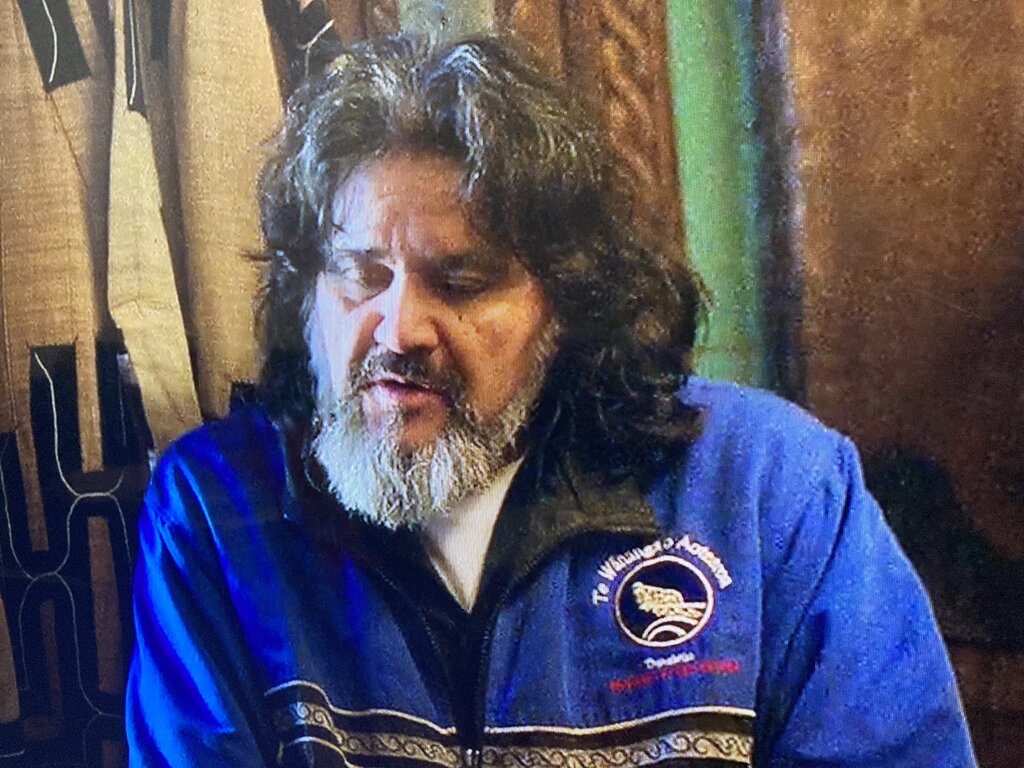
The reason why I posted the picture from the film at the beginning was because I was really surprised that the actor was wearing a jacket from Te Wānanga o Aotearoa, a Māori-run university here in New Zealand.
I had known that the Ainu people visit New Zealand to learn from the successful cultural preservation/ language revitalization strategies of the Māori people, and I guess he acquired it through one of their exchange programmes.
I was really moved to see the connection between the Ainu and the Māori in such an unexpected place!







 English Rakugo NZ