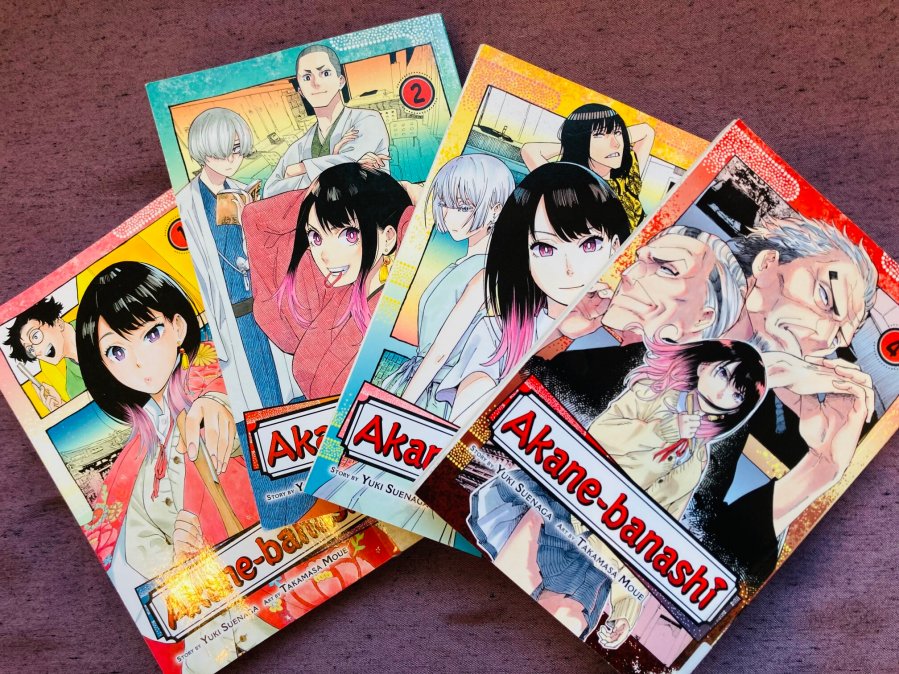
🎉 Super exciting news for rakugo and anime lovers! The acclaimed rakugo manga Akane-banashi is officially getting an anime adaptation in 2026!
If you’ve already read the manga, you know how brilliantly it captures the dynamic spirit and deep traditions of rakugo- bringing this storytelling art to audiences who may be discovering it for the first time.
What makes Akane-banashi even more special is its amazing protagonist: Akane Osaki. In a genre (shonen manga) often dominated by male leads, this Shonen Jump series stands out with a strong, determined young woman at its heart- and this alone is worth celebrating!
Created by writer Yuki Suenaga and illustrator Takamasa Moue, the story follows Akane, a girl mesmerised by her father’s rakugo performances. She spends countless hours imitating his stories, secretly watching his training sessions. But when her father is abruptly expelled from the rakugo association and forced to stop performing, Akane sets out to uncover the truth behind his dismissal. Guided by her father’s former master, she begins her own journey to become a rakugo performer.
While Showa Genroku Rakugo Shinju helped introduce rakugo to international audiences through its poignant (and sometimes super depressing…) storytelling, I believe Akane-banashi has the potential to reach even further.
Since its debut in Weekly Shonen Jump in February 2022, Akane-banashi has been a standout hit, earning nominations for both the 16th Manga Taisho Award and the 47th Kodansha Manga Award.
This is one anime adaptation you won’t want to miss!
I’m thrilled to share some exciting news about an upcoming event that celebrates the rich tapestry of cultures in our vibrant city—”World of Cultures”!
I will be doing a rakugo performance/ workshop at the event, but there will also be a taiko performance and an origami workshop on the day!
Join me on Saturday, 5 April 2025, at Epsom Library for a day filled with the enchanting traditions of Japan. I am still not sure about the exact timing of the rakugo performance/ workshop, but I will post it here and my SNS once confirmed.
Happy Lunar New Year! Wishing you and your family peace, happiness, and good fortune!
To celebrate this special occasion, I have decided to write a beginner’s guide to rakugo. It is based on an introduction video that I made for YouTube, but I thought a note that accompanies it would be good addition for you to deepen your understanding of rakugo 😊 So…
Have you ever stumbled upon this storytelling tradition that’s both ancient and strikingly modern? Enter the world of rakugo, the Japanese traditional art of comic storytelling that blends storytelling with theatrical flair. It’s more than just comedy; it’s a window into Japanese culture and a testament to the power of narrative (I dare say!). Hopefully, this guide will introduce you to the unique and exciting world of rakugo!
What Exactly is Rakugo?
At its heart, rakugo is a 400-year-old Japanese tradition of comic storytelling. While you might initially think that it might be like stand-up comedy performed sitting down, but it is actually quite different. It’s a form of narrative performance where the goal is to engage and captivate the audience, not just make them laugh. Rakugo stories can be incredibly diverse, ranging from lighthearted ghost stories and tragedies to fantastical tales, erotica, and even science fiction. I personally see it like a sitcom or an old-time radio show, delivered by a single storyteller.
Key Elements that Make Rakugo Unique
Traditional Meets Contemporary: Rakugo is both traditional and contemporary. Performers almost always wear kimono, honoring the traditions of the past, but the stories themselves can explore themes of the present and even the future.
Minimalist Staging: In the Tokyo (Edo) style of rakugo, performers use only two props: a fan and a tenugui (traditional Japanese towel). The fan, also known as ‘kaze’ (literally means ‘wind’) in rakugo circles, can be used to create sound effects or symbolise various objects like a calligraphy pen or chopsticks. The tenugui, also referred to as ‘mandala’, is a highly versatile prop that can represent anything from a book to a wallet or even a smartphone!
The Art of the Single Performer
Rakugo is performed by a single storyteller who takes on all the characters within the narrative. Very subtle head movements and shifts in gaze are used to differentiate between each character. The performer’s direction of gaze also indicates social status and whether they are indoors or outdoors.
Characters with higher social status are indicated by the performer looking stage right, while those of lower status are indicated by looking stage left.
Characters inside a building are indicated by the performer facing stage right while those outside always face towards stage left regardless of the character’s social status.
The Historical Roots of Rakugo
The origin of Rakugo is often traced back to Seigan Temple (誓願寺) in Kyoto. It’s said that a monk named Anrakuan Sakuden (1554-1642) began incorporating characters and anecdotes into his Buddhist sermons to keep his students engaged. His approach was a means of enlivening what might otherwise be considered dry religious teachings. He compiled a book called Seisuishou (醒酔笑) in 1623, marking a significant milestone in the history of rakugo.
Rakugo further developed in two major Japanese cities with regional differences:
Osaka/ Kyoto: Rakugo initially evolved as a lively street performance, incorporating music and sound effects.
Edo (Tokyo): In Tokyo, rakugo became more of a theatrical performance, focusing on the art of storytelling with minimal props.
Why Should You Experience Rakugo?
Rakugo is a unique experience, far removed from the typical Western theatrical fare. It’s not just a performance; it’s a cultural memory that blends storytelling, minimalist performance, and a connection to Japan’s history. Whether you’re seeking a different kind of comedy or an enriching cultural experience, rakugo offers a journey into a world that is both familiar and wonderfully unique… and sometimes VERY quirky!
If you prefer just watching the video… (maybe I should’ve put the video above, but hey I wanted you to read the article!)
Hope you had some good breaks during the Christmas and New Year holidays!
As a heavily Kiwi-fied person, I am finally kicking off my work year today after the 3 weeks of summer holidays… Perhaps, it is not appropriate to call it ‘summer holidays’ as I spent the most of it in the icy cold Japan. Anyway, I feel very stagnant, and it’s about time to get on with my creative projects!
During my stay in Japan, I got to perform rakugo in English three times; twice at Asakusa Culture Tourist Information Center and once with my master’s rakugo family. It was especially a huge privilege for me to perform with my rakugo family, who are basically some of the top “English Rakugo” performers in Japan.
The photo above is from the performance with my rakugo family. (From the left, Eishi, Showman, Eiraku, Ichirin, Panda, and Koraku). Eiraku (my master), Ichirin, and Koraku are the founders of the English Rakugo Association.
There are some exciting projects coming in, but one of the biggest news so far is that the rakugo-inspired artwork that was exhibited at Christchurch Art Gallery (New Zealand) and Tampere Art Museum (Finland) will be displayed at an art museum in Hiroshima, Japan! More information to follow. (If you are interested in this art project, you can read my past entry here.)
I will also resume school visits if my funding application is approved. I will probably be able to offer 5-10 free performance-workshops. Keep an eye out for this page and/ or my SNS.
There will be an open performance/ workshop at Epsom Library on Saturday, 5 April 2025 as a part of the World of Cultures celebrations.
Also, I am planning to stay in Japan for a longer period at the end of this year, and I would like to expand my performance opportunities there. Please contact me if you are interested in collaborating with me sometime between November 2025- January 2026 in Japan.
Finally, though I have said this over and over… I really want to make my YouTube work this year! Please follow my channel if you still haven’t and also give me suggestions to make it work.
As a few people have asked me if I am willing to revive the rakugo club, I am writing this to suss out if there is enough interest out there to resume the group.
Learning from my past mistakes, I will approach it a bit differently this time if you are interested in participating in this only rakugo community in New Zealand.
As it is the traditional way, I am still willing to teach rakugo free of charge. However, this time I’d like the participants to organise a venue for me. I want to focus on just teaching rakugo (in the past, I had to do most of the admin myself).
This time I will make, for example, a 10 week-long curriculum to end the term with a public performance. I’d like students who actually want to perform at the end of the programme.
The problem of a free programme was that many people didn’t show up regularly, but this time I’d expect participants to show up at least 80% of the sessions.
I have a few women’s kimono donated to the club for you to use, but otherwise you will need to organise your own kimono. A very cheap ones can be purchased for $30-50 at Asia Gallery Kimono Emporium.
If you don’t live in Auckland, please do not contact me regarding this (as it happens a lot!). If you do, I am sorry but I will disregard your message!
If you are interested in getting involved, please message me via the contact page or one of my SNS.