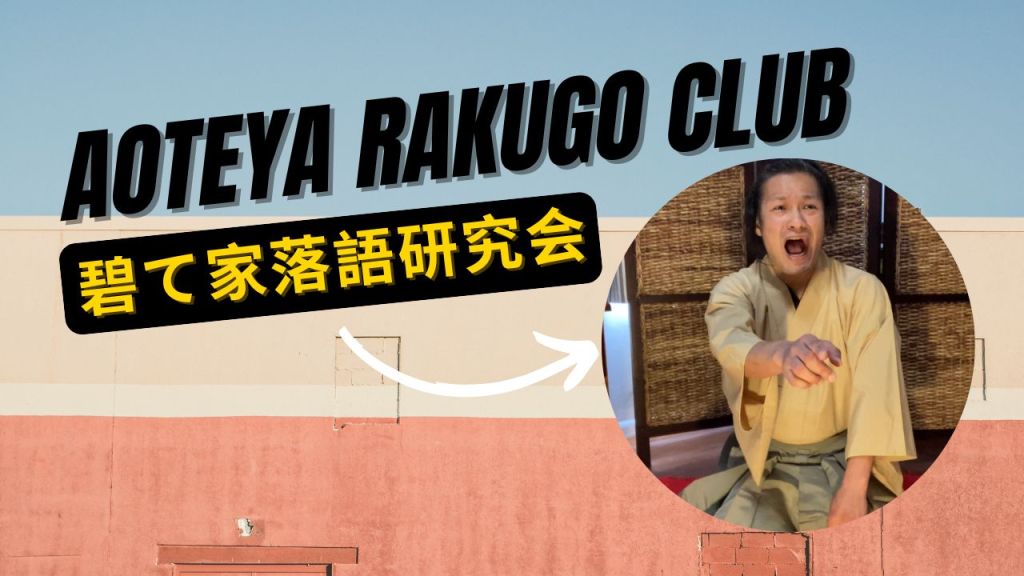
As a few people have asked me if I am willing to revive the rakugo club, I am writing this to suss out if there is enough interest out there to resume the group.
Learning from my past mistakes, I will approach it a bit differently this time if you are interested in participating in this only rakugo community in New Zealand.
As it is the traditional way, I am still willing to teach rakugo free of charge. However, this time I’d like the participants to organise a venue for me. I want to focus on just teaching rakugo (in the past, I had to do most of the admin myself).
This time I will make, for example, a 10 week-long curriculum to end the term with a public performance. I’d like students who actually want to perform at the end of the programme.
The problem of a free programme was that many people didn’t show up regularly, but this time I’d expect participants to show up at least 80% of the sessions.
I have a few women’s kimono donated to the club for you to use, but otherwise you will need to organise your own kimono. A very cheap ones can be purchased for $30-50 at Asia Gallery Kimono Emporium.
If you don’t live in Auckland, please do not contact me regarding this (as it happens a lot!). If you do, I am sorry but I will disregard your message!
If you are interested in getting involved, please message me via the contact page or one of my SNS.
It’s been a while to update my website, but hope everything is well with you all 😊
I have been performing mainly for educational institutions for the last few months, but 2 public performances are coming up very soon!
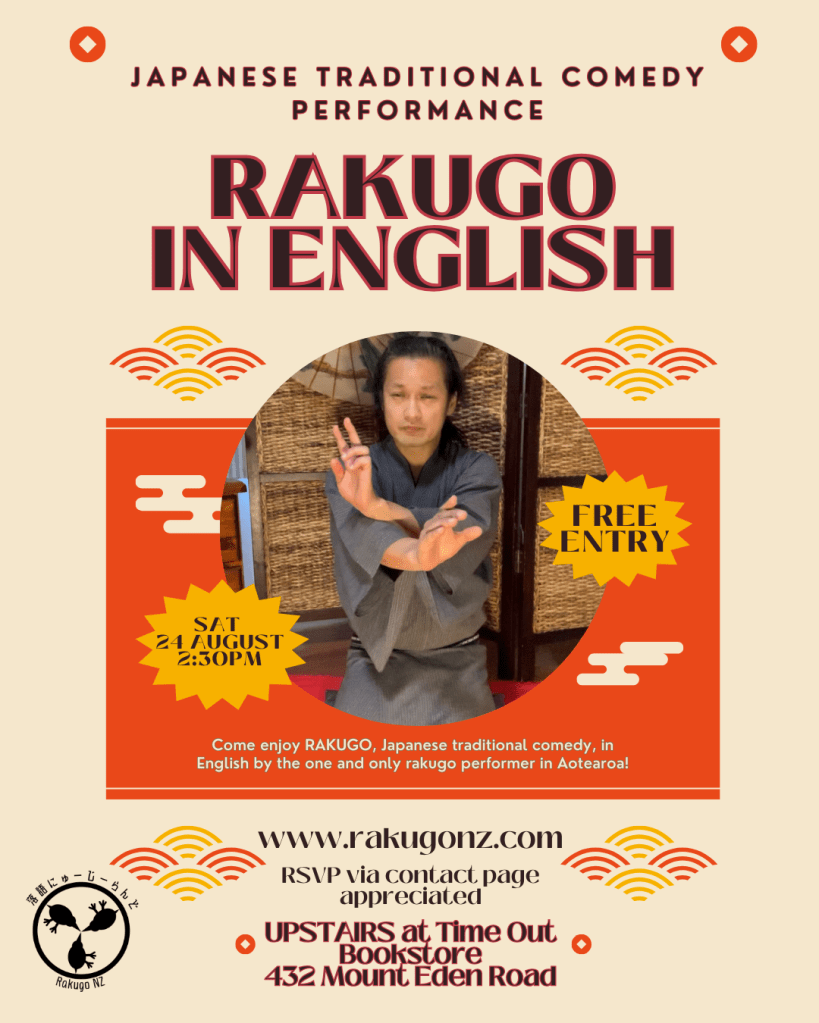
One will be at UPSTAIRS of my favourite bookstore, Time Out(432 Mt Eden Road), and the other will be on Whānau Day 2024 at the prestigious Māori theatre, Te Pou (2 Mt Lebanon lane, Henderson)!
* To clarify the notice on Whānau Day 2024, ‘Rakugo’ is the right spelling of my art, and my real name ‘Hiroshi’, instead of my stage name Kanariya Eishi, is shown (which is actually seen as a no-no in the rakugo world), but I’m still super grateful!
Please do RSVP via contact page or one of my SNS if you are coming to the Time Out performance. RSVP not required for Whānau Day.
I normally pick which stories to perform while I’m on stage, but I have realised it’d be more audience friendly if I let them know before the performance, so here’s my plan:
Time Out(Sat 24 August)
Story 1: The Zoo (動物園) Story 2: Licking a Kettle (やかんなめ)
Te Pou(Sat 7 September)
Story 1: Jugemu (寿限無) Story 2: The Zoo (動物園)
Hope to see you there! Don’t forget to RSVP if you are coming to Time Out!
It’s been 8 months since I closed my Twitter/ X account.
The platform was getting filled up with hate speech, misinformation, and trolls, and I no longer wanted to be a cog for the billionaire’s virtual playground where I was one of his products.
But… I have to admit that I later regretted my decision when my account was completely swiped off the system. I really felt, then, that regardless of all the cons, what mattered the most was the real people on the other side of the digital sinkhole.
I almost felt guilty that I chose my dislike of the platform over the real people who I knew in real life and those who I’d possibly meet in the unforeseen future.
Having said that, it’s time to move on.
The problem with X was that a single powerful person (or an egomaniac?) dominated the entire platform. Unfortunately, this could potentially happen to all other centralised platforms including Meta-owned sites like Facebook, Instagram, Threads, or even WhatsApp, which means pretty much all the major platforms in the world.
However, as a true “indie of indies”, I cannot do without SNS to share my work as a rakugo performer, and this has been a huge dilemma to me.
In an ideal world, I’d rather meet and chat with people face-to-face rather than only connecting with them virtually. But I’ve been told by my producer and actor friends that I must keep at least one major platform, which according to them is Instagram, Facebook, or X. In fact, one of the recent contracts that I signed said, I have an obligation to share the event that I’m involved in at least 3 times via my SNS, so I literally can’t get rid of them 😁
Then, enters the Fediverse concept.
I don’t fully understand it, but it’s basically a collection of social networking sites that can communicate with each other, therefore not bound by one single individual or company unlike other platforms.
In Fediverse, you can move around between platforms. So even if you close down your current account, you can take it with you to another platform.
WordPress, Mastodon, and Bluesky probably are the most famous ones, but recently Threads (half-) entered the Fediverse.
It seems like some instances (or servers) have rejected to connect with Meta-owned Threads as it might interfere with their internet freedom. I don’t really know enough about the consequences of their participation, but we’ll see.
But for now, to look ahead for the future, it’d make sense for me to stick with platforms in the Fediverse.
You are most likely to find my latest news and thoughts on Mastodon and Threads… for the time being.
I have a large stack of the lucky charms that my dear mother in Japan have sent me over the last 20 plus years.
We avoid numbers like 4 and 9 because 4 (四 shi) rhymes with death (死 shi) while 9 (九 ku) rhymes with suffering (苦 ku).
When I turned 44, my mum sent me heaps of lucky charms to ward off bad luck. I can predict that I’ll be bombarded with some more lucky charms when I turn 49 next year.
Having said that, I grew up more of a cynical sceptic, taking after my dad.
So I thought, but I recently realised that I am actually both sceptic and superstitious- just like the rest of Japan.
Most of us say that we are non-religious, but we love visiting shrines, temples, and even churches and vaguely believe in the unseen world. We are not atheists as some westerners say.
Since I started learning about the traditional Māori calendar called maramataka, I’ve got really curious about our own traditional calendar, and I’ve been learning about it for the last few months.
First, look at the Japanese calendar of this month (June 2024) below. Most of our calendars tell us the luck of each day.
For example, 24th June 2024 is a Taian (大安), one of the luckiest days, and many Japanese weddings are held on a Taian.
On the other hand, 17th June 2024 is a Butsumetsu (仏滅), and it’s the unluckiest day in Japanese calendar. Most couples avoid this day to get married.
As I grew up, I’d always thought Taian was the luckiest day, but I have recently learned that there are luckier days in the year.
It is called Tenshanichi (天赦日 てんしゃにち), which only happens 5-6 times a year. It is believed that all the gods rise up to the heavens and forgive all the sins of people on this day.
When Taian and Tenshanichi overlap, it is even more auspicious.
There is another lucky day called Ichiryumanbaibi (一粒万倍日 いちりゅうまんばいび), which literally means “the day one seed turns into 10,000 seeds”.
I have to say that one of the highlights from my recent Japan trip was Tōkōin Temple (東光院) in my hometown, Oiso.
Mind you, I am not at all a religious person.
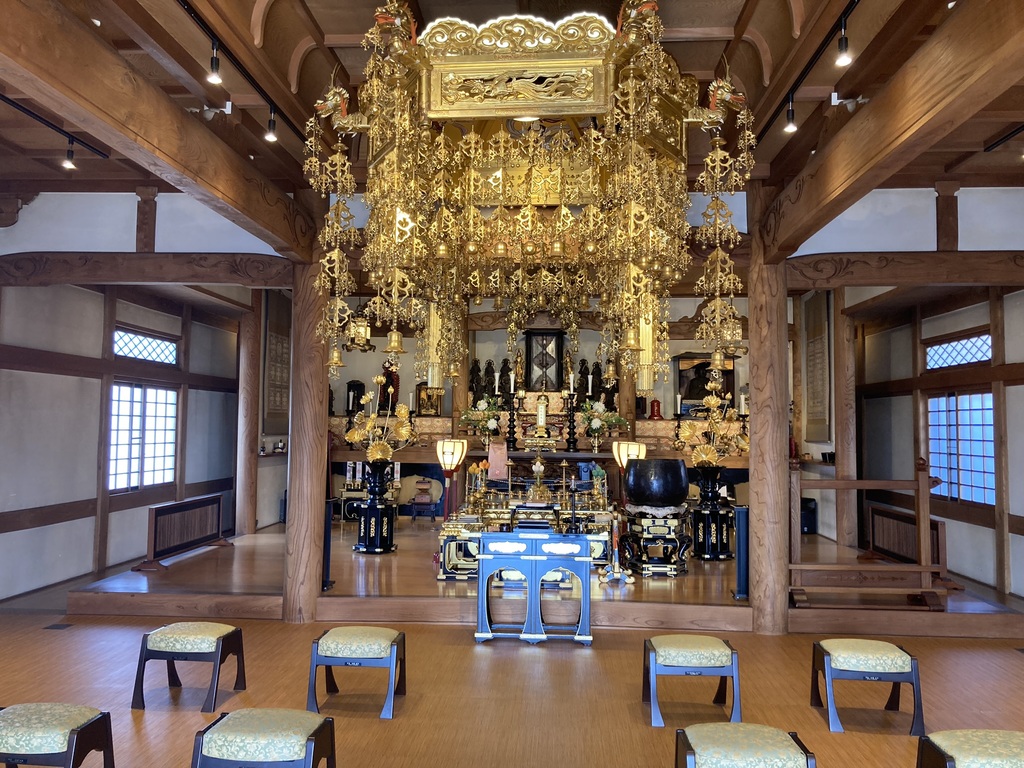
I only visited this temple to pay respect to my uncle who passed on during the pandemic, but this temple really blew my mind and showed me what it is to adapt our old traditions to this ever-changing world.
As you would know, not taking off your shoes to enter a Japanese house is a cardinal sin.
If I’m allowed to be a bit passive aggressive right now, each time my NZ European family members and friends walk into my house with their shoes on, I’m internally very, VERY cross! (Now you know!)
This cultural rule is upheld even more strictly at places of worship such as shrines, temples, and even some churches in Japan.
But, as you can see in one of the pictures above (“Keep your shoes on” sign), this temple broke this sacred cultural law to make the sanctuary barrier free for the elderly and people with disability (you need to bend down to remove your shoes, which is hard for them).
I was born and raised in Japan and spent about 21 years of my life there, but it was the very first time to visit a temple that allows you to keep your shoes on… in the sanctuary!!!
They also removed tatami mattresses and placed chairs in the sanctuary so that people don’t have to sit in the seiza position. It is a seiza-free temple!!!
I don’t know any other temple that does this. Please comment below if you know any other temple like this one in Japan… This is that rare!
But what really surprised me doesn’t end here.
This temple has a cozy community space with a library which is completely open to the public- anyone can just walk in and use it to study, to work, up to you.
When my family entered the space, there were a lot of after-school primary school students, reading manga, playing games together, or doing homework.
Then joined one of the monks (who once was a boxer!), and they all started watching the Final of 2023 World Baseball Classic together!
As you may know, Japan beat US and won the championship this year 😁
Did I say that the temple also provides tea, coffee, hot lemon drink, and sometimes even snacks free of charge.
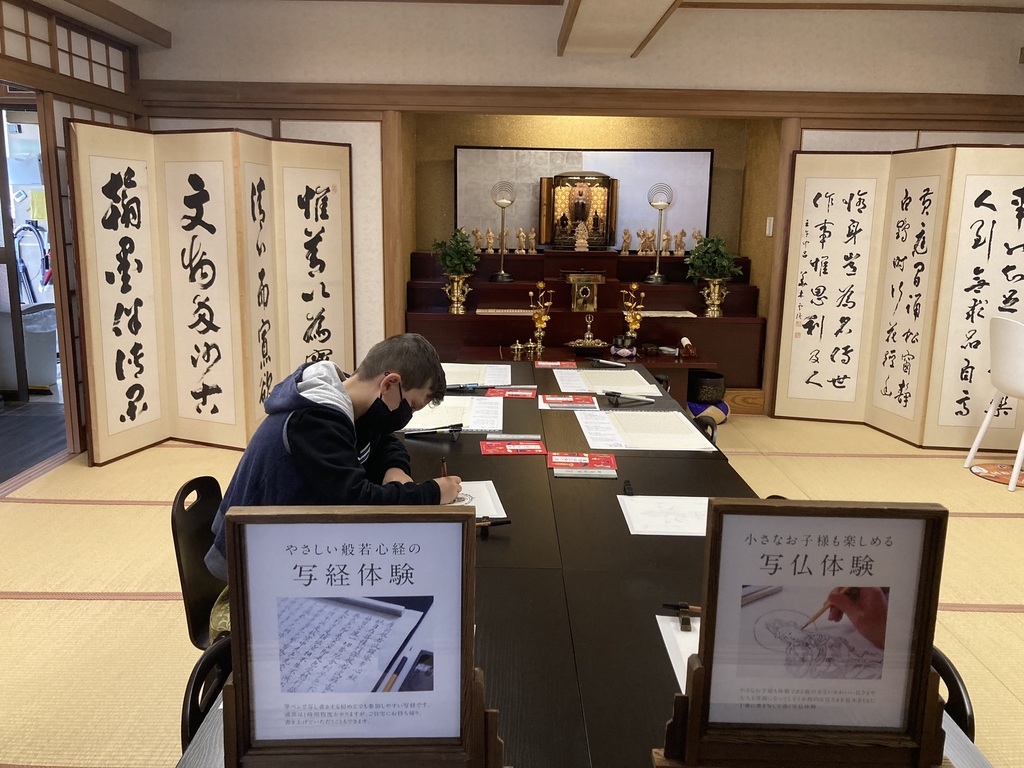
If you want to have some quiet time to meditate, there is space available, too, where you can do sutra copying (写経) or “shabutsu” (写仏), which is a meditative practice to trace pictures of Buddha and other Buddhist deities.
My son was really amused by the tracing activity and completed it in a few minutes- though it’s supposed to be done very slowly to contemplate.
The temple also works closely with doctors, nurses, social workers, psychotherapists to offer free help for those who cannot afford these kinds of services themselves.
They invite academics to do open lectures on non-Buddhist subjects like economics as well.
There are even more radical things they do, but I’ll stop here to not to bore you!
My learning from their adaptability is that traditional arts such as rakugo also have to keep evolving, adapting themselves to the time, here and now. I have to say this temple is way ahead of the world of rakugo.










 English Rakugo NZ