Surprisingly Elegant, Narita

『奥様が座席から落ちないよう、奥様のシートベルトをしっかりとお締めください。』
“Okusamaga zasekikara ochinaiyou, okusamano seatbelt wo shikkarito oshimekudasai.”

…was the inflight announcement by a Kiwi cabin crew, who was excellent at Japanese.

His Japanese was literally perfect… except for one word.

In Japanese, “okusama” is a wife, and “okosama” is a child, so instead of saying, “Please fasten your child’s seatbelt so that they do not fall off their seats,” he encouraged us to fasten our wives’ seatbelts- which I did.

Completely unrelated reminiscence from the flight, but yes… Narita!

As you know, Narita International Airport is Japan’s main international airport, and it’s often referred as “Tokyo/ Narita Airport” because its original name was “New Tokyo International Airport”.

This is such a deceptive marketing.

The airport is NOT in Tokyo… AT ALL.

It is in Chiba Prefecture and takes about 80 minutes by an express train to get to Central Tokyo.

It takes at least 3hrs to travel to my hometown in Kanagawa Prefecture.

Before children, we used to travel straight to my hometown after the 11hr flight from New Zealand, but this is not realistic anymore.

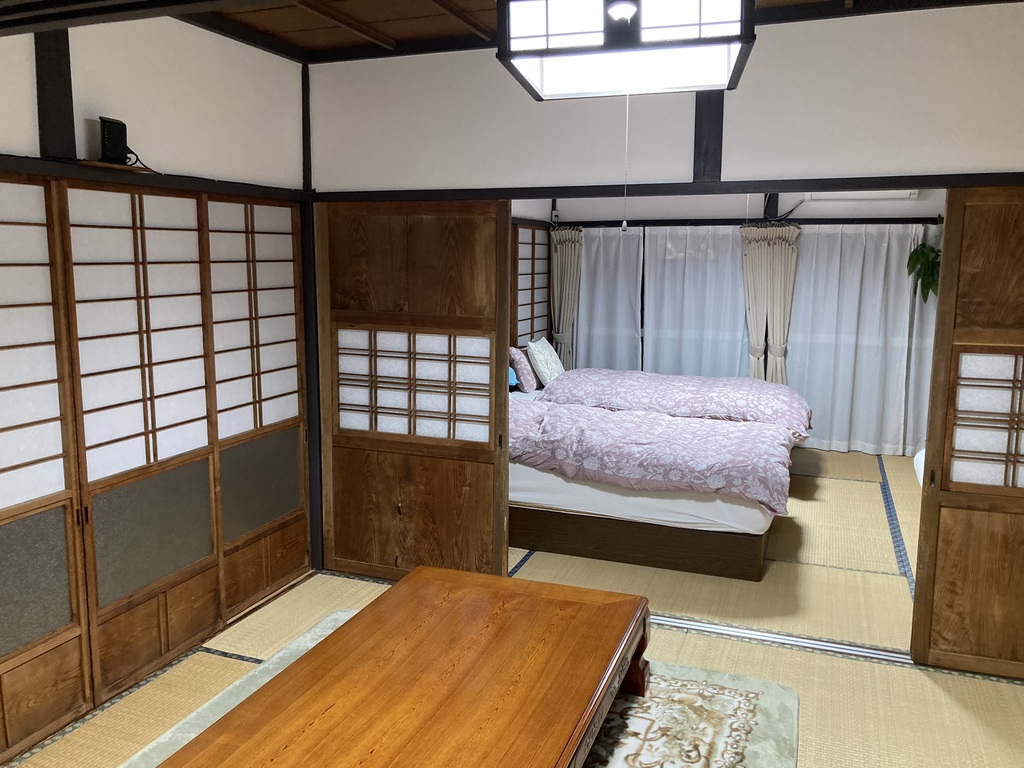
So… we decided to stay at an accommodation nearby for the night to be refreshed before the train journey to my hometown the next day.

This place was only 1.5km from the airport, and the friendly hosts even came to pick us up at the airport!

They have 5-star reviews from over 279 reviewers as of today- no wonder their service was excellent!

But what surprised me the most was how quiet this entire suburb was.

Unlike my preconception, it was very rural and spacious. I couldn’t believe the airport was less than 2km away!

As I explored the community, I realised that this area was full of history. I just hadn’t realised this as I’d always bypassed right through this area to go overseas/ home before this.

The host told me a lot of stories about the Narita area, and now I’m planning to explore properly next time.

During the morning walk, we discovered a historical farmhouse nearby that had belonged to an American farmer in the Meiji period (1868- 1912) then to the Imperial family. The exterior of the house can be seen in the photo above.

You can probably see that both the Japanese and the western elements are mingling together in the design of the house. We describe this sort of cultural remix as “Wa-Yo-Set-Chu” (わようせっちゅう 和洋折衷).

Perhaps, I’m a good example of a Wa-Yo-Set-Chu person.

Come to think of it, my graduation theatre project at an American university was called “Wa-Yo-Set-Chu with the Mad Japanese Man”… seriously.

Rakugoka (落語家) vs. Hanashika (噺家)

In Japanese, Rakugo (落語) means a story with a punchline, and Rakugo storytellers are called Rakugoka (落語家).

Another common way to call them is Hanashika (噺家), which simply means a storyteller. In my personal opinion, this expression captures what Rakugo performers do more accurately.

Even though Rakugo is almost always accepted as a form of comedy in Japan and also introduced overseas as such, Rakugo is not always funny. If you have ever listened to stories like “Shinkei Kasanegahuchi” (真景累ヶ淵), “Bunshichi Mottoi” (文七元結 ), or “Tachikiri” (立切り), you would understand this.

“Shinkei Kasanegahuchi” is a pure tragedy, a horror story with very little humour. “Bunshichi Mottoi” is a human drama that would make you cry (I cry every time I listen to it!). “Tachikiri” is a heartbreaking love story, which also brings you tears.

I do not think Rakugo would have received the same kind of popularity if it was just comedy.

It is an all inclusive storytelling art.

I really appreciate that the manga/ anime/ TV drama
“Descending Stories: Showa Genroku Rakugo Shinju” (昭和元禄落語心中) has captured this multifaceted nature of Rakugo rather well.

The beauty of the expression Hanashika (噺家) is that the kanji “噺” is used instead of “話”, which is the most common character to mean a story.

The character “噺” can be broken into “口” (mouth) and “新” (new), so as a whole it means uttering something new.

As a traditional art, the Rakugo World has faced two missions: one being to protect the tradition and the other being progressing it so that it will remain relevant for generations to come.

To me personally, the act of “uttering something new” captures what they do as performers of this traditional art.

My Rakugo Resolutions 2019!

I guess it’s about time to share ’em, eh?

Happy New Year! 明けましておめでとうございます!

Hope you had fantastic Christmas and New Year’s celebrations with your beloved ones! If you are interested, you can check out what I was up to during the holidays on my Twitter.

As the Heisei Period is coming to a close in less than 3 months in Japan, I am feeling this groundless hope for a new beginning! I can already feel that this year will be AMAZING!!!

It’s already been 10 days into 2019, and I guess it’s about time to disclose my Rakugo resolutions for this year!

As I tend to be unrealistic about my goals (& I almost always don’t reach them…), I have decided to set realistic goals that are reachable yet not too easy this year.

Here are my resolutions for 2019!

  • Do 50 performances minimum: As I am traveling most of January, I have 11 months to accomplish this. Due to my health, this might be a bit challenging but doable!
  • Learn 12 new Rakugo stories minimum (1 of which has to be my original story)
  • Learn 30 new Kobanashi (short stories/ one-liners)
  • Finish 1st draft of my Rakugo book: It’s been about 70% done for a very long time…
  • Wellington tour: If you are a Wellingtonian, please host me!
  • Improve “small talk” skills: This is probably the most embarrassing goal to share here, but I really suck at small talks. If you know me well, I am an enthusiastic conversationalist when it comes to “big topics” (ex. politics, philosophy, or even meaning of life), but I am very poor at the initial stage of relationship building. My Rakugo career would probably go further if I mastered this skill, which I really should have learned when I was a teenager.

Now I have shared these publicly. There’s no going back!

Have an AMAZING year, everybody!