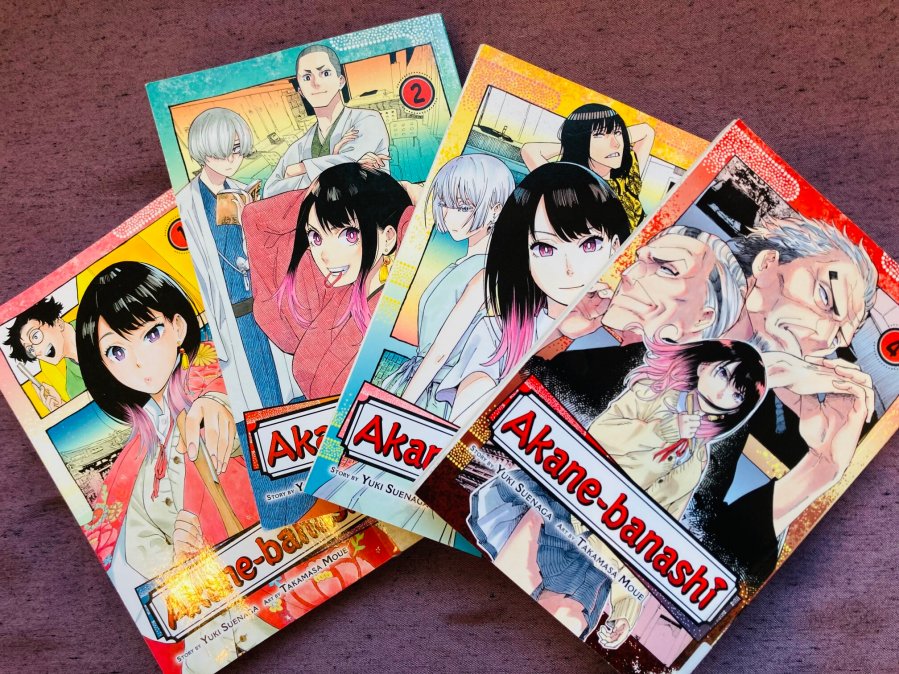
“Akane-banashi” THE Rakugo Manga is Getting a TV Anime in 2026!

🎉 Super exciting news for rakugo and anime lovers! The acclaimed rakugo manga Akane-banashi is officially getting an anime adaptation in 2026!

If you’ve already read the manga, you know how brilliantly it captures the dynamic spirit and deep traditions of rakugo- bringing this storytelling art to audiences who may be discovering it for the first time.

What makes Akane-banashi even more special is its amazing protagonist: Akane Osaki. In a genre (shonen manga) often dominated by male leads, this Shonen Jump series stands out with a strong, determined young woman at its heart- and this alone is worth celebrating!

Created by writer Yuki Suenaga and illustrator Takamasa Moue, the story follows Akane, a girl mesmerised by her father’s rakugo performances. She spends countless hours imitating his stories, secretly watching his training sessions. But when her father is abruptly expelled from the rakugo association and forced to stop performing, Akane sets out to uncover the truth behind his dismissal. Guided by her father’s former master, she begins her own journey to become a rakugo performer.

While Showa Genroku Rakugo Shinju helped introduce rakugo to international audiences through its poignant (and sometimes super depressing…) storytelling, I believe Akane-banashi has the potential to reach even further.

Since its debut in Weekly Shonen Jump in February 2022, Akane-banashi has been a standout hit, earning nominations for both the 16th Manga Taisho Award and the 47th Kodansha Manga Award.

This is one anime adaptation you won’t want to miss!

How to use chopsticks properly?

Did you know how to use chopsticks properly?

More importantly, did you know how to split ‘waribashi’ or the disposable chopsticks correctly?

Here‘s a video that I made to explain just that with a bit of humour: https://www.facebook.com/reel/1665815060994430/

It’s for St Pierres Sushi, which I’d been a big fan of since before this project. It’s a fun project to work on, so hope it will go on for a bit.

Please like/ comment to let them know what you think!

Social Media Dilemma

It’s been 8 months since I closed my Twitter/ X account.

The platform was getting filled up with hate speech, misinformation, and trolls, and I no longer wanted to be a cog for the billionaire’s virtual playground where I was one of his products.

But… I have to admit that I later regretted my decision when my account was completely swiped off the system. I really felt, then, that regardless of all the cons, what mattered the most was the real people on the other side of the digital sinkhole.

I almost felt guilty that I chose my dislike of the platform over the real people who I knew in real life and those who I’d possibly meet in the unforeseen future.

Having said that, it’s time to move on.

The problem with X was that a single powerful person (or an egomaniac?) dominated the entire platform. Unfortunately, this could potentially happen to all other centralised platforms including Meta-owned sites like Facebook, Instagram, Threads, or even WhatsApp, which means pretty much all the major platforms in the world.

However, as a true “indie of indies”, I cannot do without SNS to share my work as a rakugo performer, and this has been a huge dilemma to me.

In an ideal world, I’d rather meet and chat with people face-to-face rather than only connecting with them virtually. But I’ve been told by my producer and actor friends that I must keep at least one major platform, which according to them is Instagram, Facebook, or X. In fact, one of the recent contracts that I signed said, I have an obligation to share the event that I’m involved in at least 3 times via my SNS, so I literally can’t get rid of them 😁

Then, enters the Fediverse concept.

I don’t fully understand it, but it’s basically a collection of social networking sites that can communicate with each other, therefore not bound by one single individual or company unlike other platforms.

In Fediverse, you can move around between platforms. So even if you close down your current account, you can take it with you to another platform.

WordPress, Mastodon, and Bluesky probably are the most famous ones, but recently Threads (half-) entered the Fediverse.

It seems like some instances (or servers) have rejected to connect with Meta-owned Threads as it might interfere with their internet freedom. I don’t really know enough about the consequences of their participation, but we’ll see.

But for now, to look ahead for the future, it’d make sense for me to stick with platforms in the Fediverse.

You are most likely to find my latest news and thoughts on Mastodon and Threads… for the time being.

Superstitious Japanese: Luckiest Days of the Year

I have to say that Japanese are superstitious.

I have a large stack of the lucky charms that my dear mother in Japan have sent me over the last 20 plus years.

We avoid numbers like 4 and 9 because 4 (四 shi) rhymes with death (死 shi) while 9 (九 ku) rhymes with suffering (苦 ku).

When I turned 44, my mum sent me heaps of lucky charms to ward off bad luck. I can predict that I’ll be bombarded with some more lucky charms when I turn 49 next year.

Having said that, I grew up more of a cynical sceptic, taking after my dad.

So I thought, but I recently realised that I am actually both sceptic and superstitious- just like the rest of Japan.

Most of us say that we are non-religious, but we love visiting shrines, temples, and even churches and vaguely believe in the unseen world. We are not atheists as some westerners say.

Since I started learning about the traditional Māori calendar called maramataka, I’ve got really curious about our own traditional calendar, and I’ve been learning about it for the last few months.

First, look at the Japanese calendar of this month (June 2024) below. Most of our calendars tell us the luck of each day.

For example, 24th June 2024 is a Taian (大安), one of the luckiest days, and many Japanese weddings are held on a Taian.

On the other hand, 17th June 2024 is a Butsumetsu (仏滅), and it’s the unluckiest day in Japanese calendar. Most couples avoid this day to get married.

As I grew up, I’d always thought Taian was the luckiest day, but I have recently learned that there are luckier days in the year.

It is called Tenshanichi (天赦日 てんしゃにち), which only happens 5-6 times a year. It is believed that all the gods rise up to the heavens and forgive all the sins of people on this day.

When Taian and Tenshanichi overlap, it is even more auspicious.

There is another lucky day called Ichiryumanbaibi (一粒万倍日 いちりゅうまんばいび), which literally means “the day one seed turns into 10,000 seeds”.

It is a good day to start a new project.

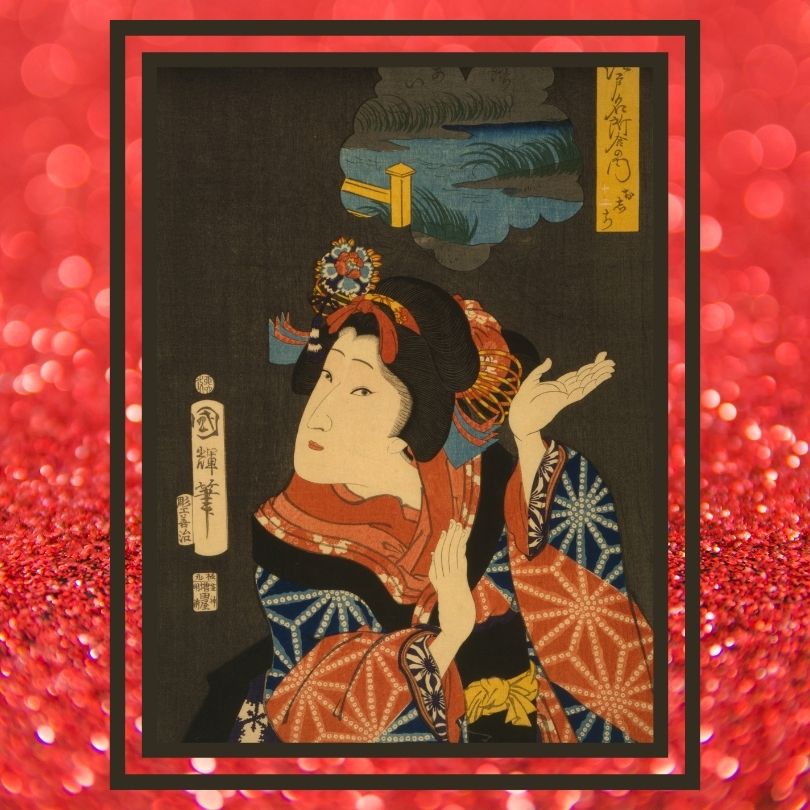
Yaoya Oshichi (八百屋お七 1667- 1683)

Yaoya Oshichi (八百屋お七 1667- 1683) is one of the Japanese historical figures who have been immortalised by many novels, kabuki/ bunraku plays, movies and songs including a book called ‘Kōshoku Gonin Onna’ (好色五人女) by the literary giant, Ihara Saikaku (井原 西鶴 1642-1693).

The title of this book translates as ‘Five Women Who Loved Love’. It is a compilation of 5 tragic love stories. I am captivated by this book and have deep respect and empathy for these women who chose love in the time when choosing true love wasn’t an option.

The story began during a great fire of Edo. Oshichi’s family escaped to Kichijo Temple, and they stayed there as a temporary shelter. There Oshichi fell in love with a temple worker called Kichizaburo.

Oshichi’s family house and business (greengrocer) were rebuilt, so they moved out of the temple.

These two lovers kept on kindling their love regardless of many obstacles.

However, one night, Oshichi missed Kichizaburo so much that she could no longer tolerate their circumstance.

As a fire had united them for the first place, she decided to cause another fire herself, hoping this would bring them together once again…

Fortunately, the fire was contained quickly.

Back then, arson resulted in death penalty, and the legal age to be convicted for arson was 16.

The judge was a kind man that he tried to save her by pretending that she was only 15:

“You must be 15 years old, are you not?” “No, I am 16 years old, Sir.”

Then, the judge asked her again:

“You must be 15 years old, are you not?”

Without picking up the hint, Oshichi answered, “I am 16 years old, Sir” once again.

Therefore, she was convicted and burnt at the stake.

Meanwhile, Kichizaburo had fallen sick and only learned about her death 100 days later.

Devastated by the passing of his love, he became a well-respected monk, and served the poor and even used his own money to build a bridge for the community.