The True Name of the “Thunder Gate”

Kaminarimon (Thunder Gate)

One of the most famous landmarks in Japan is Kaminarimon (雷門; かみなりもん) or the “Thunder Gate” in Asakusa, Tokyo.

Along with Mt. Fuji, Tokyo Skytree, and Tokyo Tower, it is no exaggeration to say that it is recognised by virtually all Japanese people.

But did you know that “Kaminarimon” (Thunder Gate) is just a nickname for this gate?

Many Japanese do not even know this, but its real name is “Furaijinmon” (風雷神門; ふうらいじんもん) or “The Gate of the Gods of Wind and Thunder”.

If you look closely at the picture above, you’d probably notice that there are two deities displayed on the sides of the gate.

The one on the left with the drums is Raijin (雷神 らいじん) or the god of thunder. He makes thunder with those drums.

I remember as a child I was told to hide my belly button as Raijin likes to eat it for whatever reason…

The one on the right is Fujin (風神 ふうじん) or the god of wind.

Therefore, the official name of Kaminarimon is Furaijinmon.

In fact, if you look at the giant red lantern from the other side, its official name is actually written on it.

Furaijinmon (風雷神門; ふうらいじんもん)

Asakusa is one of the destinations that I definitely recommend you to visit once the Corona crisis is over.

The remnants of the Edo period (1603-1867) can be still felt in this area, and it is widely considered the heart of the Edo culture. For rakugo lovers, it is also known as the home of Asakusa Engei Hall (浅草演芸ホール), one of the four full-time rakugo venues in Tokyo.

I am so looking forward to visiting Asakusa again myself!

Asakusa Engei Hall

Photo Credits

Asakusa Engei Hall: Kakidai, CC BY-SA 3.0 https://creativecommons.org/licenses/by-sa/3.0, via Wikimedia Commons

Furaijinmon: Moyan Brenn from Italy, CC BY 2.0 https://creativecommons.org/licenses/by/2.0, via Wikimedia Commons

Kaminarimon at night: Steve Collis from Melbourne, Australia, CC BY 2.0 https://creativecommons.org/licenses/by/2.0, via Wikimedia Commons
Short Film “Half-Life”

This year I’ve had an honour of working closely with a multi-talented artist, Fiona Amundsen.

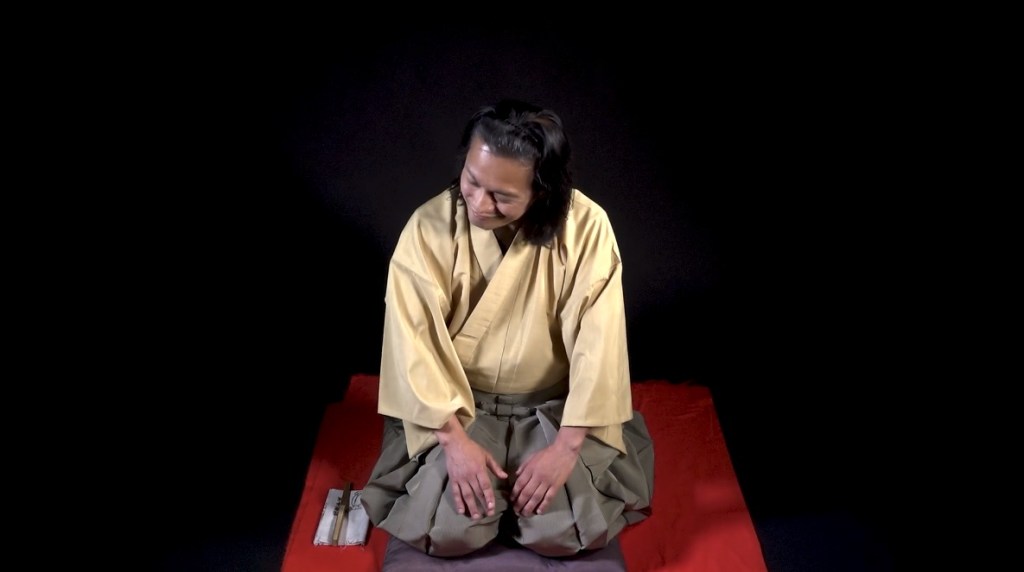
About two months ago, our short film, which incorporates rakugo, the Aikido concept of “zanshin” (残心), and remembrance of WWII, was released on Asia New Zealand Foundation’s digital platforms.

This work was a part of “IN TOUCH arts commissions” by the foundation, and I feel very privileged to be a part of this project.

You can still view this film/ artwork, but before you watch it, I’d like you to know a few things:

  1. My family’s experience in Nagasaki is only a personalised way of remembering our mistakes as humanity as a whole. I am deeply ashamed of what my Japanese ancestors did to many Asian nations and others, and this is no way our attempt to victimise Japanese.
  2. It is our way of finding the universal message of peace in the ordinary, everyday things.
  3. Part 1 is very dark and many may give up watching the rest, but Part 2 has some humour in it based on my own experience with my grandfather. But Part 2 only makes sense if you watch Part 1…

I decided to write this first because someone who probably hadn’t watched the work nor read the interview commented as below on the foundation’s SNS:

“Great idea! Let’s remember Nanking, Rangoon, Singapore, Jakaraka [sic], Port Moresby, and many many others too shall we?”

This work was created to do exactly that!

Here is the link to our work. You can also find our interviews on the page. Some of the super intellectual comments are by Fiona 😁

You can find other commissioned work here.

May peace prevail upon us all!

Kia tau te rangimārie ki a tatou katoa!

我々と共に平和がありますように。

Four Defenders of Japanese Festivals

At Japanese festivals, four banners with the pictures of the four divine beings are sometimes displayed.

You might have also seen them at a ceremony at the imperial palace.

They are the defenders of Shin’iki (神域 しんいき) or the sanctuary of the shrine.

These four defenders are: Blue Dragon (青龍 せいりゅう Seiryu; the defender of the east), White Tiger (白虎 びゃっこ Byakko; the defender of the west), Vermilion Bird (朱雀 すざく Suzaku; the defender of the south), and Black Tortoise (玄武 げんぶ Genbu; the defender of the north; usually entwined together with a snake).

Together these four flags are called “Four Godly Flags/ Banners” (四神旗 しじんき Shijinki).

But in the Edo period (1603-1868), they were also called “Four Godly Swords” (四神剣 しじんけん Shijinken) in the Tokyo area as they put swords at the tips of the flags.

There is a hilarious rakugo story that involves a set of “Four Godly Swords”, which is based on a true story that happened at a restaurant called Momokawa (百川 ももかわ).

Unfortunately, it is one of those stories that would get lost in translation, but I will attempt explaining it another time!

See you next time!

“Mummy” Medicine of Edo!

If you are a speaker of British English, you might be slightly confused if I’m talking about an adult female human with a child/ children or a preserved human body that could’ve been a mummy… or a daddy.

If you are a speaker of American English, you are right I meant a mummy by “mummy”.

The Egyptian kind of mummy, who could’ve been an Egyptian mummy before her passing (OK, I’ll stop annoying you!).

I recently learned a shocking fact about a Japanese medicine during the Edo period (1603-1868), and I couldn’t resist sharing this particular one!

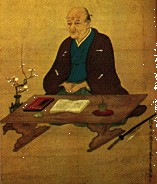
Kaibara Ekiken* (貝原益軒 1630-1714) was a very well-known Neo-Confucianist philosopher (じゅがくしゃ 儒学者) and botanist who studied the medicinal herbs used in traditional Chinese medicine.

Ekiken is especially known for his books called Yojokun (ようじょうくん 養生訓), which was a collection of his health advice, and Yamato Honzo (やまとほんぞう 大和本草) that introduced medicinal plants from China and Japan.

Yamato Honzo (やまとほんぞう 大和本草)

Kaibara Ekiken* (貝原益軒 1630-1714)

In Yamato Honzo, mummies… or mummified human bodies probably from Egypt… are introduced as a medicine!!!

Mind you, Ekiken himself opposed to the use of mummies as a medicine for ethical reasons, but researches suggest that they were widely used as all-purpose cure though they cost a fortune.

We don’t know exactly where they were imported from (and how they were sourced), but it was likely to have been via China or Netherlands as Japan only traded with these two countries then. It could’ve also been from Korea (via Tsushima), Ainu (via Matsumae/ Hokkaido), or Ryukyu/ Okinawa. **

According to Yamato Honzo, mummies were good for toothache, headache, chest pain, high fever, antidote for poisonous insects, and others.

* Some people also call him “Ekken”.

** If you know the answer to this question, please comment below!!!

Reference

貝原益軒著「大和本草」記載のミイラの薬効について 江頭啓介・原敬二郎

Photo Credit

Yamato Honzo: Momotarou2012, CC BY-SA 3.0 https://creativecommons.org/licenses/by-sa/3.0, via Wikimedia Commons

The Origin of Waribashi (Disposable Chopsticks)

If you have been to a Japanese restaurant, I’m sure you have seen those waribashi (割り箸, わりばし) or disposable wooden chopsticks that you pull apart before digging in your yummy Japanese dishes.

Personally, I have a love-and-hate relationship with them- I love them because they are sanitary; I hate them because they are an absolute waste of trees.

Anyway… I came across the origin of those chopsticks the other day, so I’m sharing it with you 😃

It is said that waribashi was first created by an eel restaurant in Edo (1603-1868), which is the old name for Tokyo.

They were originally made of bamboo and called “Hikisakibashi” (引裂箸 ひきさきばし), which roughly means “chopsticks to split apart”.

However, the wooden disposable chopsticks that we use today were actually invented in Nara Prefecture (奈良県 ならけん).

It is said that a monk called Sugihara Souan (杉原宗庵, すぎはらそうあん) invented them from Japanese cedar from the Yoshino region (so called “Yoshino Cedar”; 吉野杉, よしのすぎ) in 1827.

They used the scrap wood from making sake barrels, and even today they only use wood from forest thinning in the Yoshino region, therefore making them more ecological than the imported ones from overseas.

I personally think it’s best to use reusable metal chopsticks like Korean people do for the environment, but if you are into waribashi, I recommend you get ones from Yoshino!

References

わが国における食事用の二本箸の起源と割箸について 向井由紀子, 橋本慶子, 長谷川千鶴

You can access this document, but it takes ages to load somehow: https://www.jstage.jst.go.jp/article/cookeryscience1968/10/1/10_41/_pdf

箸の本 本田総一郎

Eishi’s Rakugo Commentary No.3 [Nopperabo のっぺらぼう]

[You can watch this rakugo story at the bottom of this post. Please let me know what you think of it!!!]

In my personal opinion, this is one of the uniquest rakugo stories of all.

This is not because it is a pure ghost story with very little laughter but mainly because it was inspired by a story written by Lafcadio Hearn or better known in Japan as Koizumi Yakumo (小泉 八雲 1850-1904).

The story of Nopperabo had already existed as folktales before his writing, but it was him who made it famous.

In 1850, Patrick Lafcadio Hearn was born in Greece to a Greek mother and an Irish father. Due to family complications, he moved to Dublin and then to the United States where he worked as a newspaper reporter.

As a correspondent, he was sent to French West Indies for 2 years, and then finally ended up in Japan where he spent the rest of his life.

He got married with a Japanese woman and became a Japanese citizen himself.

He is the reason why I am so attached to this story.

Someone from overseas bothered enough to learn, live, and love the Japanese way, and he shared his learning with the west and ended his life as a Japanese citizen.

I feel so closely to this man perhaps because I am in a little similar situation myself as someone who has spent more than half of his life overseas and married to a non-Japanese woman.

Whenever I perform this story, I think of him, and I feel immensely honoured to carry on with his story.

Going back to the story itself, it had already existed as I mentioned earlier.

There is a mention about Nopperabo in Sorori Monogatari (曽呂利物語 そろりものがたり) in 1663.

The fascinating thing about this particular Nopperabo is that he was over 2m tall!!!

In general, people believed that animals such as foxes, racoon dogs, or mujina (Japanese badgers) turned into Nopperabo and tricked humans.

In Koizumi’s version, the culprit was a mujina.

You can read the original story here on The Project Gutenberg website. As you can see, the term “Nopperabo” is somehow not used in his story.

Now you can watch Nopperabo below and see how the original evolved into a rakugo story.

References

のっぺらぼう

Lafcadio Hearn