Uncover the Magic of Rakugo: A Beginner’s Guide to Japanese Comic Storytelling

Happy Lunar New Year! Wishing you and your family peace, happiness, and good fortune!

To celebrate this special occasion, I have decided to write a beginner’s guide to rakugo. It is based on an introduction video that I made for YouTube, but I thought a note that accompanies it would be good addition for you to deepen your understanding of rakugo 😊 So…

Have you ever stumbled upon this storytelling tradition that’s both ancient and strikingly modern? Enter the world of rakugo, the Japanese traditional art of comic storytelling that blends storytelling with theatrical flair. It’s more than just comedy; it’s a window into Japanese culture and a testament to the power of narrative (I dare say!). Hopefully, this guide will introduce you to the unique and exciting world of rakugo!

What Exactly is Rakugo?

At its heart, rakugo is a 400-year-old Japanese tradition of comic storytelling. While you might initially think that it might be like stand-up comedy performed sitting down, but it is actually quite different. It’s a form of narrative performance where the goal is to engage and captivate the audience, not just make them laugh. Rakugo stories can be incredibly diverse, ranging from lighthearted ghost stories and tragedies to fantastical tales, erotica, and even science fiction. I personally see it like a sitcom or an old-time radio show, delivered by a single storyteller.

Key Elements that Make Rakugo Unique

  • Traditional Meets Contemporary: Rakugo is both traditional and contemporary. Performers almost always wear kimono, honoring the traditions of the past, but the stories themselves can explore themes of the present and even the future.
  • Minimalist Staging: In the Tokyo (Edo) style of rakugo, performers use only two props: a fan and a tenugui (traditional Japanese towel). The fan, also known as ‘kaze’ (literally means ‘wind’) in rakugo circles, can be used to create sound effects or symbolise various objects like a calligraphy pen or chopsticks. The tenugui, also referred to as ‘mandala’, is a highly versatile prop that can represent anything from a book to a wallet or even a smartphone!

The Art of the Single Performer

Rakugo is performed by a single storyteller who takes on all the characters within the narrative. Very subtle head movements and shifts in gaze are used to differentiate between each character. The performer’s direction of gaze also indicates social status and whether they are indoors or outdoors.

  • Characters with higher social status are indicated by the performer looking stage right, while those of lower status are indicated by looking stage left.
  • Characters inside a building are indicated by the performer facing stage right while those outside always face towards stage left regardless of the character’s social status.

The Historical Roots of Rakugo

The origin of Rakugo is often traced back to Seigan Temple (誓願寺) in Kyoto. It’s said that a monk named Anrakuan Sakuden (1554-1642) began incorporating characters and anecdotes into his Buddhist sermons to keep his students engaged. His approach was a means of enlivening what might otherwise be considered dry religious teachings. He compiled a book called Seisuishou (醒酔笑) in 1623, marking a significant milestone in the history of rakugo.

Rakugo further developed in two major Japanese cities with regional differences:

  • Osaka/ Kyoto: Rakugo initially evolved as a lively street performance, incorporating music and sound effects.
  • Edo (Tokyo): In Tokyo, rakugo became more of a theatrical performance, focusing on the art of storytelling with minimal props.

Why Should You Experience Rakugo?

Rakugo is a unique experience, far removed from the typical Western theatrical fare. It’s not just a performance; it’s a cultural memory that blends storytelling, minimalist performance, and a connection to Japan’s history. Whether you’re seeking a different kind of comedy or an enriching cultural experience, rakugo offers a journey into a world that is both familiar and wonderfully unique… and sometimes VERY quirky!

If you prefer just watching the video… (maybe I should’ve put the video above, but hey I wanted you to read the article!)

Rakugo Performance Schedule

Kia ora!

It’s been a while to update my website, but hope everything is well with you all 😊

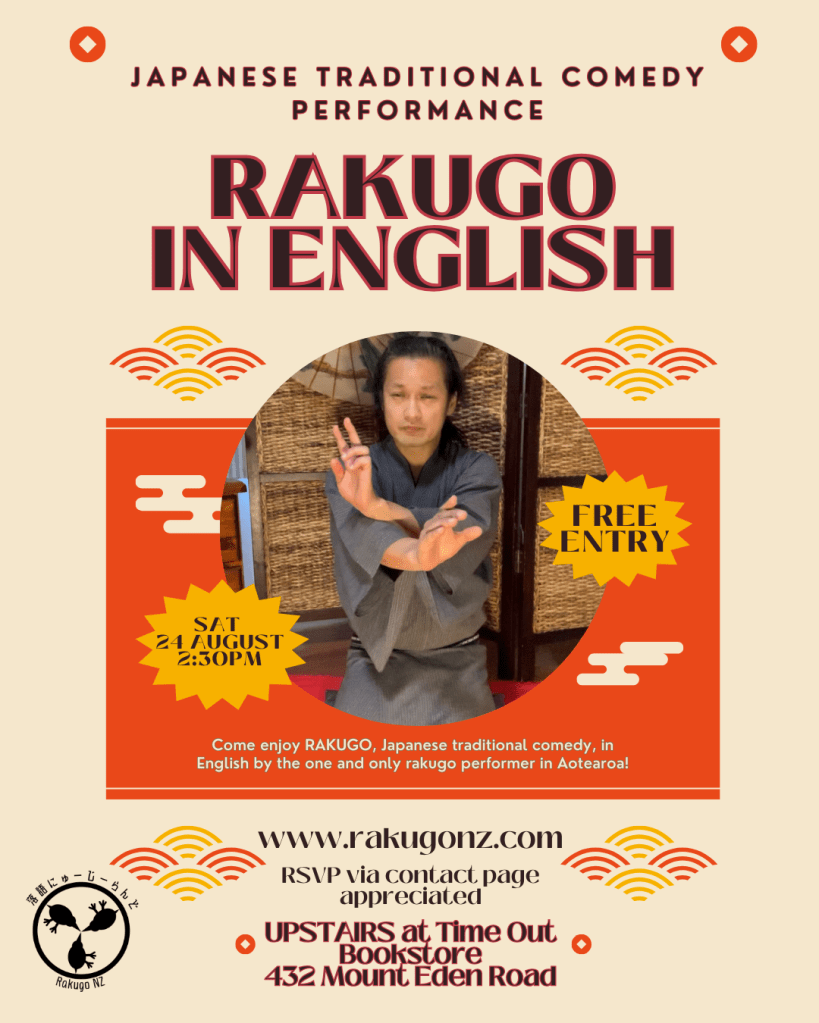
I have been performing mainly for educational institutions for the last few months, but 2 public performances are coming up very soon!

One will be at UPSTAIRS of my favourite bookstore, Time Out (432 Mt Eden Road), and the other will be on Whānau Day 2024 at the prestigious Māori theatre, Te Pou (2 Mt Lebanon lane, Henderson)!

* To clarify the notice on Whānau Day 2024, ‘Rakugo’ is the right spelling of my art, and my real name ‘Hiroshi’, instead of my stage name Kanariya Eishi, is shown (which is actually seen as a no-no in the rakugo world), but I’m still super grateful!

Please do RSVP via contact page or one of my SNS if you are coming to the Time Out performance. RSVP not required for Whānau Day.

I normally pick which stories to perform while I’m on stage, but I have realised it’d be more audience friendly if I let them know before the performance, so here’s my plan:

Time Out (Sat 24 August)

Story 1: The Zoo (動物園) Story 2: Licking a Kettle (やかんなめ)

Te Pou (Sat 7 September)

Story 1: Jugemu (寿限無) Story 2: The Zoo (動物園)

Hope to see you there! Don’t forget to RSVP if you are coming to Time Out!

Goodbye Twitter!

After long thought, I have finally decided to say goodbye to my favourite SNS, Twitter… or whatever you call it.

I was a big Twitter fan and used it as my main SNS platform since the early days of my English Rakugo career in New Zealand. It was there that I met many invaluable friends who have inspired and encouraged me to carry on this rather lonely journey. For this, I am eternally thankful to you all!

This decision was made largely due to the new owner of the platform and the increasingly divisive contents that people post on the once-friendlier space (I am also guilty of occasionally posting progressive left posts myself, though! 😁).

So… Threads, Instagram, and Facebook will be my SNS platforms from now on. I like the Twitter format, so Threads will probably be my main platform. Sorry Mastodon, I’ve tried, but I still don’t know how it works…

Online Rakugo Project Starting Next Week!

As some of you may know, I spent the last two months recovering from a major-ish disc injury.

I am not writing this to get your sympathy, but I am just telling you why my “Online Rakugo Project” did not happen for so long.

Having said that, I am glad to announce that I have finally filmed two of my rakugo stories, and I will start posting them from next week!

In this Creative New Zealand funded project, I will post 10 very different rakugo stories on my online platforms, mainly YouTube and possibly Vimeo and IGTV.

If you still haven’t, please follow my YouTube channel as it will be an incentive for me to keep posting videos after this project is over. Please share about it with your friends and family as well.

I was initially not too sure whether to post videos as it is a consensus among rakugo fans that rakugo would not work in the video format. It is much more suited for the audio media.

Also, it would inevitably expose my limited skills and make it open to criticisms from rakugo purists (please be easy on me!), but I decided to post them for the following reasons:

  • I have been requested by quite a few people over the last few years. If that’s what my supporters want, I will provide! I perform rakugo for those people, not for critics 😃
  • As the world faces the Covid crisis, I want to cheer up people through my project, even if it is for a slightly bemused chuckle. Throughout my childhood, my peers always told me I had a “bored-sounding voice” (つまらなそうな声) but had a funny face. I probably should make the most of my “gifted” face.
  • It will be a good record of how primitive my skills were, looking back 10 years from now.

Finally, I was torn whether to have a small live audience for recordings or not. It is now possible to have an audience in NZ, and it is so much easier to perform in front of one. But I decided to talk straight to the camera instead, in solidarity with people in countries that are still majorly affected by the virus.

The first story “Chotan” is a little unusual pick to kick off the project with, but I couldn’t resist as I like performing quirky stories. It is translated as “Long-Tempered vs. Short-Tempered”, and it is a story about two best friends, one being extremely laidback, the other being quick-tempered. Hope you will enjoy it!

I will post it sometime next week!