Uncover the Magic of Rakugo: A Beginner’s Guide to Japanese Comic Storytelling

Happy Lunar New Year! Wishing you and your family peace, happiness, and good fortune!

To celebrate this special occasion, I have decided to write a beginner’s guide to rakugo. It is based on an introduction video that I made for YouTube, but I thought a note that accompanies it would be good addition for you to deepen your understanding of rakugo 😊 So…

Have you ever stumbled upon this storytelling tradition that’s both ancient and strikingly modern? Enter the world of rakugo, the Japanese traditional art of comic storytelling that blends storytelling with theatrical flair. It’s more than just comedy; it’s a window into Japanese culture and a testament to the power of narrative (I dare say!). Hopefully, this guide will introduce you to the unique and exciting world of rakugo!

What Exactly is Rakugo?

At its heart, rakugo is a 400-year-old Japanese tradition of comic storytelling. While you might initially think that it might be like stand-up comedy performed sitting down, but it is actually quite different. It’s a form of narrative performance where the goal is to engage and captivate the audience, not just make them laugh. Rakugo stories can be incredibly diverse, ranging from lighthearted ghost stories and tragedies to fantastical tales, erotica, and even science fiction. I personally see it like a sitcom or an old-time radio show, delivered by a single storyteller.

Key Elements that Make Rakugo Unique

  • Traditional Meets Contemporary: Rakugo is both traditional and contemporary. Performers almost always wear kimono, honoring the traditions of the past, but the stories themselves can explore themes of the present and even the future.
  • Minimalist Staging: In the Tokyo (Edo) style of rakugo, performers use only two props: a fan and a tenugui (traditional Japanese towel). The fan, also known as ‘kaze’ (literally means ‘wind’) in rakugo circles, can be used to create sound effects or symbolise various objects like a calligraphy pen or chopsticks. The tenugui, also referred to as ‘mandala’, is a highly versatile prop that can represent anything from a book to a wallet or even a smartphone!

The Art of the Single Performer

Rakugo is performed by a single storyteller who takes on all the characters within the narrative. Very subtle head movements and shifts in gaze are used to differentiate between each character. The performer’s direction of gaze also indicates social status and whether they are indoors or outdoors.

  • Characters with higher social status are indicated by the performer looking stage right, while those of lower status are indicated by looking stage left.
  • Characters inside a building are indicated by the performer facing stage right while those outside always face towards stage left regardless of the character’s social status.

The Historical Roots of Rakugo

The origin of Rakugo is often traced back to Seigan Temple (誓願寺) in Kyoto. It’s said that a monk named Anrakuan Sakuden (1554-1642) began incorporating characters and anecdotes into his Buddhist sermons to keep his students engaged. His approach was a means of enlivening what might otherwise be considered dry religious teachings. He compiled a book called Seisuishou (醒酔笑) in 1623, marking a significant milestone in the history of rakugo.

Rakugo further developed in two major Japanese cities with regional differences:

  • Osaka/ Kyoto: Rakugo initially evolved as a lively street performance, incorporating music and sound effects.
  • Edo (Tokyo): In Tokyo, rakugo became more of a theatrical performance, focusing on the art of storytelling with minimal props.

Why Should You Experience Rakugo?

Rakugo is a unique experience, far removed from the typical Western theatrical fare. It’s not just a performance; it’s a cultural memory that blends storytelling, minimalist performance, and a connection to Japan’s history. Whether you’re seeking a different kind of comedy or an enriching cultural experience, rakugo offers a journey into a world that is both familiar and wonderfully unique… and sometimes VERY quirky!

If you prefer just watching the video… (maybe I should’ve put the video above, but hey I wanted you to read the article!)

Happy New Year 2025!

Happy New Year! 新年あけましておめでとうございます!

Hope you had some good breaks during the Christmas and New Year holidays!

As a heavily Kiwi-fied person, I am finally kicking off my work year today after the 3 weeks of summer holidays… Perhaps, it is not appropriate to call it ‘summer holidays’ as I spent the most of it in the icy cold Japan. Anyway, I feel very stagnant, and it’s about time to get on with my creative projects!

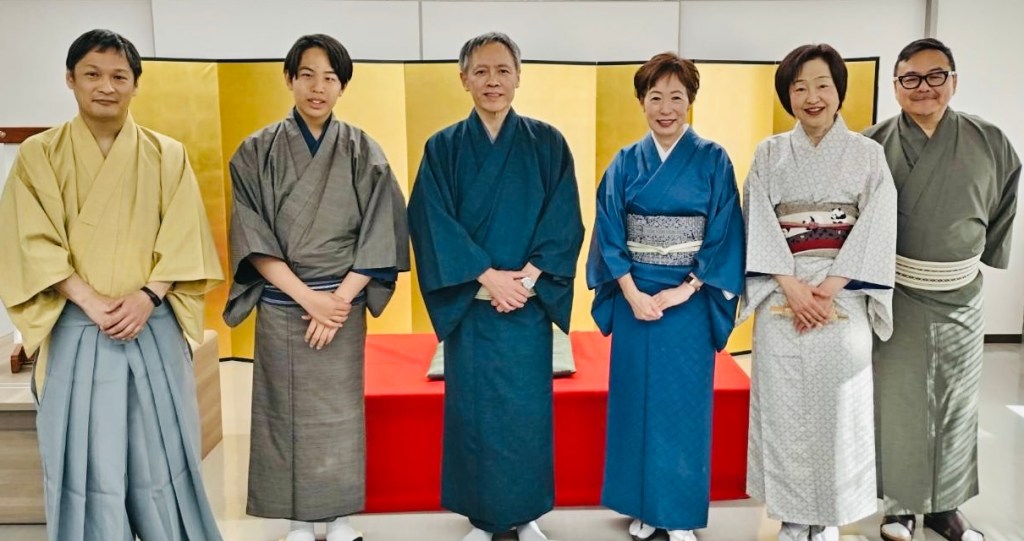
During my stay in Japan, I got to perform rakugo in English three times; twice at Asakusa Culture Tourist Information Center and once with my master’s rakugo family. It was especially a huge privilege for me to perform with my rakugo family, who are basically some of the top “English Rakugo” performers in Japan.

The photo above is from the performance with my rakugo family. (From the left, Eishi, Showman, Eiraku, Ichirin, Panda, and Koraku). Eiraku (my master), Ichirin, and Koraku are the founders of the English Rakugo Association.

There are some exciting projects coming in, but one of the biggest news so far is that the rakugo-inspired artwork that was exhibited at Christchurch Art Gallery (New Zealand) and Tampere Art Museum (Finland) will be displayed at an art museum in Hiroshima, Japan! More information to follow. (If you are interested in this art project, you can read my past entry here.)

I will also resume school visits if my funding application is approved. I will probably be able to offer 5-10 free performance-workshops. Keep an eye out for this page and/ or my SNS.

There will be an open performance/ workshop at Epsom Library on Saturday, 5 April 2025 as a part of the World of Cultures celebrations.

Also, I am planning to stay in Japan for a longer period at the end of this year, and I would like to expand my performance opportunities there. Please contact me if you are interested in collaborating with me sometime between November 2025- January 2026 in Japan.

Finally, though I have said this over and over… I really want to make my YouTube work this year! Please follow my channel if you still haven’t and also give me suggestions to make it work.

Have a fantastic year, everybody!

A Possibility of Reviving the Rakugo Club?

Kia ora!

As a few people have asked me if I am willing to revive the rakugo club, I am writing this to suss out if there is enough interest out there to resume the group.

Learning from my past mistakes, I will approach it a bit differently this time if you are interested in participating in this only rakugo community in New Zealand.

  1. As it is the traditional way, I am still willing to teach rakugo free of charge. However, this time I’d like the participants to organise a venue for me. I want to focus on just teaching rakugo (in the past, I had to do most of the admin myself).
  2. This time I will make, for example, a 10 week-long curriculum to end the term with a public performance. I’d like students who actually want to perform at the end of the programme.
  3. The problem of a free programme was that many people didn’t show up regularly, but this time I’d expect participants to show up at least 80% of the sessions.
  4. I have a few women’s kimono donated to the club for you to use, but otherwise you will need to organise your own kimono. A very cheap ones can be purchased for $30-50 at Asia Gallery Kimono Emporium.
  5. If you don’t live in Auckland, please do not contact me regarding this (as it happens a lot!). If you do, I am sorry but I will disregard your message!

If you are interested in getting involved, please message me via the contact page or one of my SNS.

Performing Rakugo on Saturday 7 September!

I’m letting you know that my rakugo performance at Te Pou Theatre is happening this weekend!

Some people have asked me what time my slot is, so here you go!

PLACE: Tāhū Studio at Te Pou (Corban Estate Arts Centre, 2 Mt Lebanon Lane, Henderson, Waitakere)

TIME (for my performance): 2:15PM-2:45PM

As I mentioned before, it’s a part of Whānau Day, and you can check out heaps of other amazing artists, too, FOR FREE!

Hope to see you there, and make sure to say hi to me!

Rakugo Performance Schedule

Kia ora!

It’s been a while to update my website, but hope everything is well with you all 😊

I have been performing mainly for educational institutions for the last few months, but 2 public performances are coming up very soon!

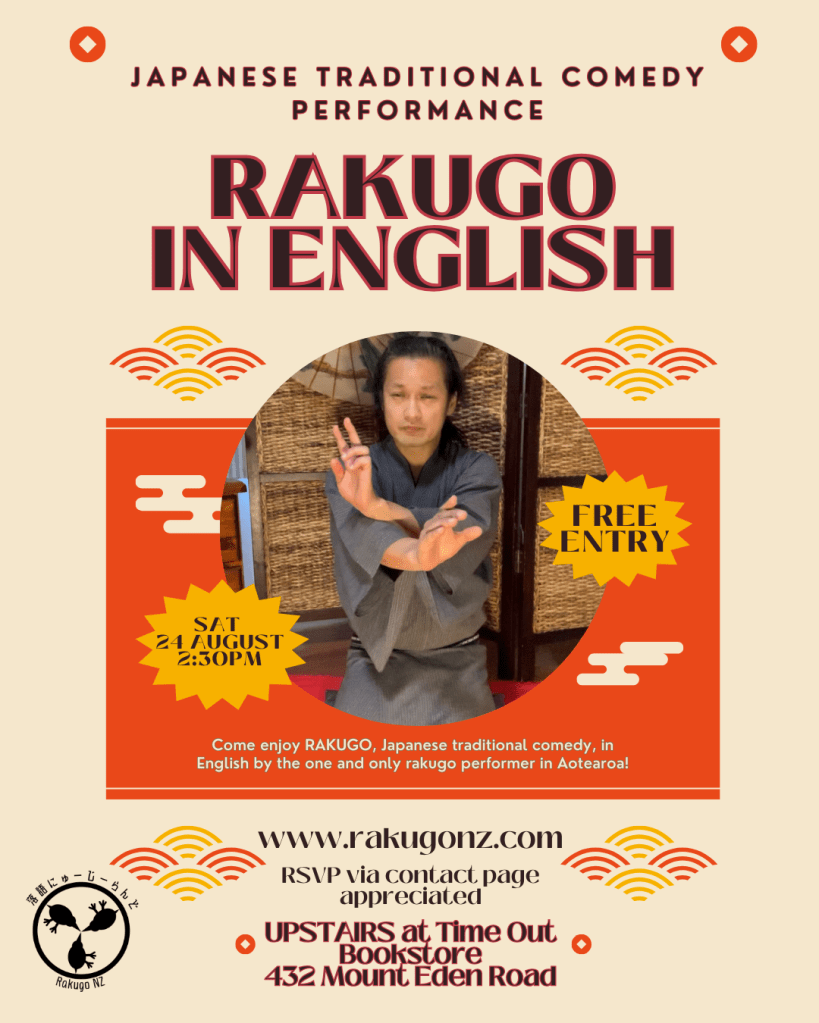
One will be at UPSTAIRS of my favourite bookstore, Time Out (432 Mt Eden Road), and the other will be on Whānau Day 2024 at the prestigious Māori theatre, Te Pou (2 Mt Lebanon lane, Henderson)!

* To clarify the notice on Whānau Day 2024, ‘Rakugo’ is the right spelling of my art, and my real name ‘Hiroshi’, instead of my stage name Kanariya Eishi, is shown (which is actually seen as a no-no in the rakugo world), but I’m still super grateful!

Please do RSVP via contact page or one of my SNS if you are coming to the Time Out performance. RSVP not required for Whānau Day.

I normally pick which stories to perform while I’m on stage, but I have realised it’d be more audience friendly if I let them know before the performance, so here’s my plan:

Time Out (Sat 24 August)

Story 1: The Zoo (動物園) Story 2: Licking a Kettle (やかんなめ)

Te Pou (Sat 7 September)

Story 1: Jugemu (寿限無) Story 2: The Zoo (動物園)

Hope to see you there! Don’t forget to RSVP if you are coming to Time Out!

Rakugoka (落語家) vs. Hanashika (噺家)

In Japanese, Rakugo (落語) means a story with a punchline, and Rakugo storytellers are called Rakugoka (落語家).

Another common way to call them is Hanashika (噺家), which simply means a storyteller. In my personal opinion, this expression captures what Rakugo performers do more accurately.

Even though Rakugo is almost always accepted as a form of comedy in Japan and also introduced overseas as such, Rakugo is not always funny. If you have ever listened to stories like “Shinkei Kasanegahuchi” (真景累ヶ淵), “Bunshichi Mottoi” (文七元結 ), or “Tachikiri” (立切り), you would understand this.

“Shinkei Kasanegahuchi” is a pure tragedy, a horror story with very little humour. “Bunshichi Mottoi” is a human drama that would make you cry (I cry every time I listen to it!). “Tachikiri” is a heartbreaking love story, which also brings you tears.

I do not think Rakugo would have received the same kind of popularity if it was just comedy.

It is an all inclusive storytelling art.

I really appreciate that the manga/ anime/ TV drama
“Descending Stories: Showa Genroku Rakugo Shinju” (昭和元禄落語心中) has captured this multifaceted nature of Rakugo rather well.

The beauty of the expression Hanashika (噺家) is that the kanji “噺” is used instead of “話”, which is the most common character to mean a story.

The character “噺” can be broken into “口” (mouth) and “新” (new), so as a whole it means uttering something new.

As a traditional art, the Rakugo World has faced two missions: one being to protect the tradition and the other being progressing it so that it will remain relevant for generations to come.

To me personally, the act of “uttering something new” captures what they do as performers of this traditional art.