Secrets Hidden in Japanese Names

One of the most common questions I get asked while living overseas is what my real name Hiroshi means.

My usual answer is something like, “Hiroshi could mean many different things, but my name means to ‘break through life with ambition’.”

As you wise readers may know, the meaning of a Japanese name is not determined by its sound but the kanji or Chinese characters used in the name.

In the old days in Japan, most people didn’t bother spending hours referring to the ancient myths or fortune tellers to come up with the perfect names for their precious babies.

The first sons/ daughters often had a kanji character “一” (one) in their names. The second children “二” (two), the third “三” (three), and so on.

My grandpa was the third son of the family, so his name was “三都彦” (Mitsuhiko). As you can see, the kanji “三” (three) is used.

Two of the superstar characters in rakugo are Hachigoro (八五郎) and Kumagoro (熊五郎).

You may have noticed, but the kanji character “五” (five) is used in both of their names.

That’s right. They were probably the fifth sons of the family.

So… what does this imply?

In the past, the first sons were the sole heirs of the family unless there were special reasons why they couldn’t act as the head of the family.

Inevitably, they received preferential treatments from their family and were sometimes even spoiled by their parents and relatives.

However, the second sons onward were just the supporting acts for the first sons.

What usually happened in the countryside in particular was to send non-heir sons to Edo (Tokyo), Osaka, or other large cities so that they would find their own means of supporting themselves.

So the names Hachigoro and Kumagoro imply that they were sort of outcasts whom their families probably didn’t care much about.

Rakugo is the art of the commoners.

Rakugo performers during the Edo period (1603-1868) did not even belong to the four social classes of the day: samurai warriors, farmers, artisans, and merchants in the order of importance.

In fact, they belong to the “non-human” status.

Rakugo was an interpretation of this world from the rock bottom of the society.

This is what makes rakugo immensely human.

Booze Drinking Giant Snake

Hi all, how’s everything going? Hope things are well over there!

Let’s begin today’s post by addressing the elephant in the room.

The title does sound like an enigmatic phrase on one of those funky Japanese t-shirts… or perhaps a rock band from Tokyo.

English is my second language after all.

Anyway…

Have you ever heard a Japanese person say “You drink a lot! Like a giant snake (uwabami)!” (よく飲むねえ。ウワバミだ。)

This is a rather archaic expression that you often come across in rakugo, but it is still used to playfully describe a person who drinks a lot.

In fact, my sister’s nickname was “Uwabami” when she was at university.

She was (possibly still is) a heavy drinker…

Recently, this expression made me wonder what its origin would be.

When did Japanese people start believing that large snakes drink a lot of alcohol?

The answer lies in the books “Kojiki” (古事記) and “Nihon Shoki” (日本書紀) that recorded our foundation myths.

They are like Genesis in the bible, but there are two books written from different perspectives.

I am sure there are many theories, but I learned at high school that Kojiki was written to educate the commoners about our beginning while Nihon Shoki acted more like an official document for the government.

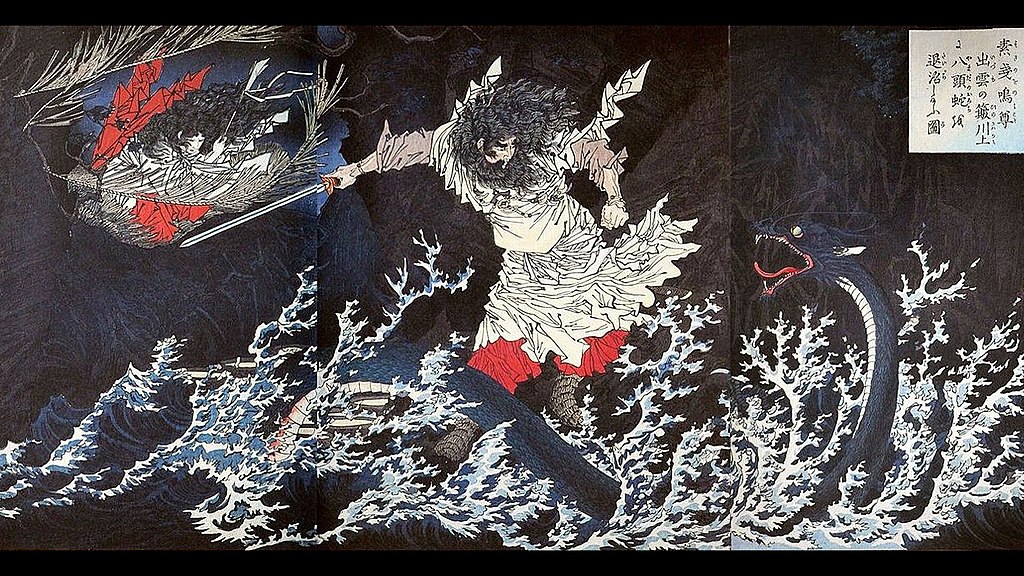
According to these books, our first recorded giant snake was called Yamata no Orochi (やまたのおろち 八岐大蛇). This monster had eight heads and eight tails. As you can see in the pictures, he could’ve been more like a dragon.

Once a year, this rogue snake appeared and demanded the eight daughters of earthly deities called “Foot-Stroking-Elder”(アシナヅチ 足名椎命) and “Hand-Stroking Elder” (テナヅチ 手名椎命).

Their eight daughters were eaten, one by one, every year.

Now there was only one daughter left.

Then comes our hero Susanoo no Mikoto (スサノオノミコト 須佐之男命).

He was a god who had been kicked out of Heaven for tricking his sister Ameterasu-Ōmikami (天照大御神 あまてらすおおみかみ), the sun goddess of Japan.

Susanoo had an excellent idea!

He decided to take a lot of alcohol for the giant serpent (who probably should’ve dealt with his alcohol issues before too late) to get him drunk before slaying this monster.

His plan worked, and the last daughter of the couple with the unfortunate names survived.

Inside one of the eight tails was a sword called “Kusanagi no Tsurugi” (草薙の剣), which became one of the three Imperial Regalia of Japan along with Yata no Kagami (八咫鏡) mirror and Yasakani no Magatama (八尺瓊勾玉) jewel.

So there you go…

The Japanese expression “Uwabami” (giant snake) comes from the Yamata no Orochi story.

That’s all, really.

Hope you enjoyed it!

Image Attribution

Toyohara Chikanobu (豊原周延), Public domain, via Wikimedia Commons

Tsukioka Yoshitoshi (月岡芳年, Japanese, *1839, †1892), Public domain, via Wikimedia Commons

Reference

Yamata no Orochi

Cosmetics of Edo: Am I Beautiful?

Our desire for beauty, whether you are a man or a woman, is universal.

If we had a choice, most of us would probably opt in for looking gorgeous than the other way around. (To avoid misunderstanding and potential loss of readership, I would like to add that beauty is in the eye of the beholder.)

The people of Edo (1603-1868) were no different.

Readers, be prepared to be surprised by what they used for cosmetics to stay youthful.

The most common beauty product was nuka or rice bran.

They put rice bran in a bag and washed their body with it.

It is still sold in Japan, and I have tried it a few times myself. It actually works, and your skin will be noticeably smoother.

They also used funori, a kind of seaweed.

It was used as hair product to keep their hair nice and shiny. They melted it in hot water and mixed with other ingredients like flour.

But the ultimate beauty product of Edo was…

Drum roll, please…

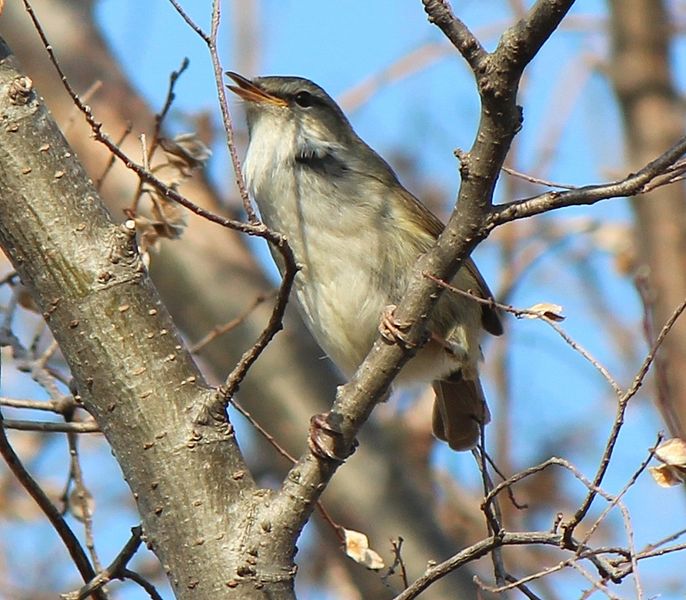
Japanese bush warbler or uguisu’s waste.

They smeared this bird’s… ahem… poop on their faces!!!

It was very expensive and cost a fortune.

I have no idea how they collected it, but that will be my next research topic.

And guess what, it is STILL used in Japan though it isn’t common, and you can purchase it online wherever you are in the world.

If you ever decide to give it a go, please send me the before and after photos.

I am very curious.

Photo Attribution

Alpsdake, CC BY-SA 3.0 https://creativecommons.org/licenses/by-sa/3.0, via Wikimedia Commons

Portuguese Words That Became Japanese- There Are More Than You Think!

Some time ago, I was listening to a rakugo story called “Gamano Abura” (蝦蟇の油 がまのあぶら) and came across a word that I did not understand.

The word was “manteika” (マンテイカ).

It made no sense whatsoever to me.

I looked up the word in my beloved rakugo dictionary (yes, there is such a thing!) and finally found out the meaning!

Of course, I didn’t understand it because it was a Portuguese word that meant “butter” (manteiga).

But in Japan, manteika meant fat from inoshishi (猪 いのしし; Japanese wild boars) or pigs, and it was used as an ointment for medical purposes.

You may not be aware of how crucial Portugal was to Japan as these two countries are literally located on the opposite sides of the word- the west end of Europe and Far East.

In 1543, the Portuguese arrived in Japan and became the first westerners to land on the country of the rising sun (some theory says it was actually 1541). They even introduced us to… guns.

Soon after in 1549, the Spanish missionaries followed and brought Christianity to Japan. Therefore, Portugal and Spain became our first portals to the western world. As Portugal was under the Spanish rule between 1581 and 1640, they were sort of under the same umbrella back then.

Naturally, the Japanese language was influenced by Portuguese/ Spanish from very early on.

“Tempura” was originally a Portuguese word as well. It was from “tempero”. The Portuguese introduced the deep frying technique to Japan, so tempura was originally NOT a Japanese dish.

Here are other Portuguese words that have become Japanese, which we still use today:

Buranko (ブランコ; from balanço) = swing

Furasuko (フラスコ; from frasco) = flask (for experiment)

Jouro (じょうろ; from jarro) = watering can

Kappa (かっぱ; from capa) = rain jacket

Karuta (カルタ; from carta) = a kind of Japanese card game

Japanese women playing karuta (circa 1900)

Konpeitou (こんぺいとう 金平糖; from confeito) = Japanese sweets as in the photo below

Konpeitou (こんぺいとう 金平糖)

Koppu (コップ; from copo) = cup

Miira (ミイラ; from mirra) = mummy (as in an Egyptian mummy, not a British mummy 😉 )

Shabon (シャボン; from sabão) = bubbles from soap

REFERENCE

日本語になったポルトガル語

日本とポルトガルの関係

PHOTO CREDIT

Midori / CC BY-SA (http://creativecommons.org/licenses/by-sa/3.0/)

[Eishi’s Japanese Trivia 2] Chinese Word Used in Edo?

Hi all, Eishi here! Hope everything is well with you all, my beloved readers!

I’ve been busy preparing for the online rakugo workshop over the last few days, but I’m finally back to blogging 🙂

In another article, I talked about the influence of a completely unexpected language on Japanese.

Here is even more fascinating trivia (at least to me) about an expression used to describe a certain social class during the Edo period (1603- 1868).

I am aware that many of my readers are Japanologists, who often know about Japanese language, culture, and history more than I do, but do you know which social class during the Edo period was called “nihonzashi” (二本差し にほんざし)?

This literally means “two swords”, so yes it’s pretty easy, it was the samurai class.

But how about “ryanko” (りゃんこ)?

Which social class did this expression mean?

Here is a hint for you.

”Ryan” (りゃん) is the Japanese transliteration of a Chinese word “liǎng” (両).

“Ko” is “個” in kanji character.

So… “Ryanko” (両個 りゃんこ) as a whole means “two pieces”…

Yep, you got it right.

This also means the samurai warriors!

It was often used by everyday people to describe samurai warriors in a slightly derogatory way, and it often appears in rakugo.

So far, I’ve talked about the influence of Lao and Chinese on the Japanese language, but I will talk about the Portuguese influence on my native language!

See you next time! Stay well and positive 🙂

A Talking Horse and the Tragic End of a Rakugo Founder

Hi everybody, Eishi here! How’s your day going?

As usual, here’s another quirky history lesson that you might enjoy.

It is about one of the founders of rakugo, the Japanese traditional art of comic storytelling.

Before moving onto the story of a talking horse, here’s a little history lesson for you.

The rakugo tradition began at Seigan Temple (誓願寺 せいがんじ) in Kyoto.

The head monk of this temple, Anrakuan Sakuden (安楽庵策伝 あんらくあんさくでん, 1554-1642), was a well-known raconteur of the day.

He compiled a joke book called “Seisuishou” (醒酔笑 せいすいしょう) with over 1,000 kobanashi (小噺 こばなし) or short stories. This 8-book series was published in 1623.

It is generally agreed that he was the founder of rakugo.

Then, this art was introduced to Osaka and initially developed as a form of street performance, incorporating lively music and wooden blocks (used like slapsticks) to get the attention of the passerby.

In Edo/ Tokyo, rakugo developed mainly as an “indoor art” that was performed in dedicated yose or rakugo theatres and zashiki or Japanese traditional rooms with tatami mattresses, paper screens, etc.

The founder of Edo Rakugo was Shikano Buzaemon (鹿野武左衛門 しかのぶざえもん).

He is the hero of the sad story I’m about to tell you.

In 1693, cholera was widespread in Japan and claimed many people’s lives.

In this national emergency, a ronin (a samurai without his master) and a greengrocer plotted a scam to get money off innocent people.

They tried to carry out their cunning plan by telling people a story something like this:

There once was a talking horse.

One day, this wise horse prophesied that nandina and Japanese plums will protect you from the plague!

We happened to have a lot of those!

Buy one, get one free!

It’s a very timely story right now, but as you can see it was not a very believable scheme.

Soon they got arrested, and the ronin was executed, and the greengrocer was sent to a remote island.

Now, these criminals confessed that they got the idea of a talking horse from Shikano Buzaemon’s book…

For this reason, he was also sent to Izu Ohshima Island (伊豆大島 いずおおしま) and died there…

What a terrible end for someone who established rakugo in Edo!!!

Rakugo performers have to be careful about what kind of stories they tell…

Hope you enjoyed this little history lesson!

If you did, please follow my YouTube channel as well.

Even though I have been sharing these stories here, my real intention is to make them into videos like the ones below.

I unfortunately can’t produce videos during the lockdown because I have my little imps aka kids hovering all over the place…

It’s only a click away to help my rakugo career. Thank you very much for your continued support!!!

Reference

落語「通」検定 社団法人落語協会