English Rakugo performer and actor based in NZ. A full-time rebel with common sense. A lover of art, books, comedy, Japanese culture/ language, music, peace, positivity, theatre, and trivia. Idealistic, but ain't no saint.
鹿鳴家英志(本名:中辻拓志)。ニュージーランドを拠点とする役者・英語落語パフォーマー。アメリカへの演劇留学をきっかけに、気付くと海外滞在20年。現在ニュージーランドに永住中。アメリカの4大卒業後は日本で英会話講師を経験、その後ニュージーランドの高校教師資格を取得する。ニュージーランドでは英語にてスタンダップコメディーを行い、2005年ニュージーランド国際コメディーフェスティバルの新人大会にて全国優勝を果たす。その後、テレビドラマ、CM等に出演、テレビのレポーターも勤める。
At this time of the year, I normally reflect on my rakugo journey and list things that I have accomplished during the year on this website.
But this year, I will instead list the names of the people who have encouraged, inspired, and supported me through this rather… memorable?… year.
I had never felt so strongly the interconnectedness of humans and that we never live alone.
So thank you every single one of you whose path crossed with mine this year to encourage/ support/ work with this one of the most indie performers in the world.
Kia ora, thank you, and doumo arigatou gozaimasu!
Asia New Zealand Foundation, Creative New Zealand, Auckland Council, University of Auckland, Auckland Libraries, Onehunga Community Centre, Babel Theatre, Auckland Playback Theatre, Paul & Echo Janman, Daniel Fernandez, Yasheeka Bertram, Kirsty Sharp, Bevan Chuang, Rina Kim, Athena Dennis, Kristine Ohkubo, Miki, Alex, Sydney Solis, Kanariya Eiraku Shisho, Kanariya Jincho, Kanariya Aimu, Fukuko Takahashi, Kumiko Imai, Aoteya Rakugo Club (Raki, Kazuma, Pukeko, Wine, and the Rakugo Girls), Fookes Family, Yee Yang ‘Square’ Lee/ Sums Selvarajan and their team, Sophie Tomlinson, Fiona Amundsen, X, M, & M, and my supportive family members.
* This list is in a completely random order, and I hope I didn’t miss out anyone…
A while ago, I made a silly video about different ways to say “I” in Japanese.
Some people have asked me in what context each expression is used, so I have decided to explain that in this article!
Hope this is helpful for you 🙂
Also… if you like this kind of video, please follow my YouTube channel, too. That will definitely make my day!!!
私(わたし Watashi): The most standard “I” in Japanese. The textbook definition!
私(わたくし Watakushi): This is a more polite version of “watashi”. As you may have noticed, the kanji for “watashi” and “watakushi” is the same “私”.
僕(ぼく Boku): This “I” is usually used by a male speaker regardless of his age. When used by an adult, it is usually with someone with an equal or a lower social standing. In recent years (especially in the manga context), some women use “boku” to address themselves as well.
俺(おれ Ore): Casual “I” used by men. It is only used with someone in the same or lower social standing or someone who is really close such as family members. This is my default “I” with my parents and older sister. I have met some non-native speakers of Japanese who think this is an impolite expression, but this is not the case as it completely depends on the context and its use is often a show of closeness to the person.
俺様(おれさま Oresama): This is the arrogant version of “ore”. I have never heard of this expression in real life except when someone is being silly on purpose. You might encounter this expression in books particularly in comic books 🙂
自分(じぶん Jibun): A formal “I”. According to this dictionary website, it was originally used as a second-person personal pronoun during the Edo period (1603-1868). In Osaka dialect, it is used to address a close friend i.e. it can also mean “you”! Confusing, isn’t it?
当方(とうほう Touhou): Wow, my sincere apology, this expression actually means “we”!!! I accidentally included it as it literally means “this side” or “the group I belong to”… but it should really be treated as “we” because the person is talking about the group s/he belongs to as a representative… Sorry!!! (You now know Japanese people don’t always know Japanese!)
身共(みども Midomo): This is a formal “I” used towards someone in the equal or lower social status.
手前(てまえ Temae): This is a humble way to refer yourself. But the confusing thing is that it could also be used to mean “you” towards someone in the same or lower social status. For this use, its variation てめえ (teme’e) is often used, but remember it is a very rude expression!
おら (Ora): This “I” is usually used in the Tohoku region. It is mainly used by men, but it is used by some old women as well.
俺っち (おれっち Orecchi): A casual and almost uncouth “I”. Not many people actually use this expression, but you do hear it spoken by some stereotypical characters in drama, manga, etc. Some people say it is the short version of “俺達” (おれたち Oretachi) or “we”.
あっし (Asshi): This is often used in “jidaigeki” or a period drama. It is often used by the craftsmen of Edo.
あたし (Atashi): Informal “I” used by women. It was used by men as well during the Edo period (1603-1868), and rakugo performers still use this expression even today. I use it myself with my rakugo friends.
あたい (Atai): This “I” feels a little archaic to me, but it is used by little children and sometimes by adult women. “Atai” is used by Yotaro, one of the star characters in rakugo!
拙者(せっしゃ): This is the “I” used by samurai warriors. You still hear it a lot in period dramas!
わし (Washi): This is a variation of “watashi” used with someone in the same or lower social status. It can sound a bit arrogant.
我 (われ Ware): This is a formal “I” that shows up often in Japanese literature, and I have never met anyone who uses this “I” in conversation.
余 (よ Yo): An archaic “I” used by the feudal lords and samurai warriors in high social status.
[You can watch this rakugo story at the bottom of this post. Please let me know what you think of it!!!]
In my personal opinion, this is one of the uniquest rakugo stories of all.
This is not because it is a pure ghost story with very little laughter but mainly because it was inspired by a story written by Lafcadio Hearn or better known in Japan as Koizumi Yakumo (小泉 八雲 1850-1904).
The story of Nopperabo had already existed as folktales before his writing, but it was him who made it famous.
In 1850, Patrick Lafcadio Hearn was born in Greece to a Greek mother and an Irish father. Due to family complications, he moved to Dublin and then to the United States where he worked as a newspaper reporter.
As a correspondent, he was sent to French West Indies for 2 years, and then finally ended up in Japan where he spent the rest of his life.
He got married with a Japanese woman and became a Japanese citizen himself.
He is the reason why I am so attached to this story.
Someone from overseas bothered enough to learn, live, and love the Japanese way, and he shared his learning with the west and ended his life as a Japanese citizen.
I feel so closely to this man perhaps because I am in a little similar situation myself as someone who has spent more than half of his life overseas and married to a non-Japanese woman.
Whenever I perform this story, I think of him, and I feel immensely honoured to carry on with his story.
Going back to the story itself, it had already existed as I mentioned earlier.
There is a mention about Nopperabo inSorori Monogatari(曽呂利物語 そろりものがたり) in 1663.
The fascinating thing about this particular Nopperabo is that he was over 2m tall!!!
In general, people believed that animals such as foxes, racoon dogs, or mujina (Japanese badgers) turned into Nopperabo and tricked humans.
In Koizumi’s version, the culprit was a mujina.
You can read the original story here on The Project Gutenberg website. As you can see, the term “Nopperabo” is somehow not used in his story.
Now you can watch Nopperabo below and see how the original evolved into a rakugo story.
As I reported in another article, the first and onlyrakugo club in Aotearoa (marketing, marketing, marketing!) has just resumed its activities after a long break due to the Covid crisis.
For those who didn’t know… which could include our establishing members… the official name of our club is Aoteya Rakugo Club.
We used to meet at the historical cottage in Albert Park in Auckland CBD, but we have relocated ourselves to Onehunga aka Eishi’s hood.
Even though we had 7 participants in the first meeting and it was a great start, I’m planning to increase our membership up to 15-20 (I will probably cut off after that).
We are looking for non-performing members as well, so you are welcome to join us as an observer and/ or a supporter of our activities.
It is free to join at this stage, thanks to the Auckland Council!!! Funding is due to its popularity, so please spread the word to keep offering this programme for free!!!
I am writing this to tell you what kind of things you can learn through this club. My sessions will cover the following:
Kimono knowledge (there will be a field trip to a Japanese antique shop to purchase kimono; cheap ones cost less than $20)
Characterisation unique to this tradition
Storytelling in general (not only bound by rakugo)
Writing and/ or translating rakugo scripts
Japanese culture in general (and also learn from different cultures)
You may have noticed, but we learn some unusual things like memory techniques, translation, and different forms of storytelling.
Over the years of working as an actor and a rakugo performer, I have learned some good memory techniques, which have freed up a lot of my time to learn scripts, and I will share them with you! I am very much into neuroscience and psychology, so my methods are evidence based 🙂
I once worked a translator, so I can help you with the translation of rakugo scripts as well.
Hope to see you there!
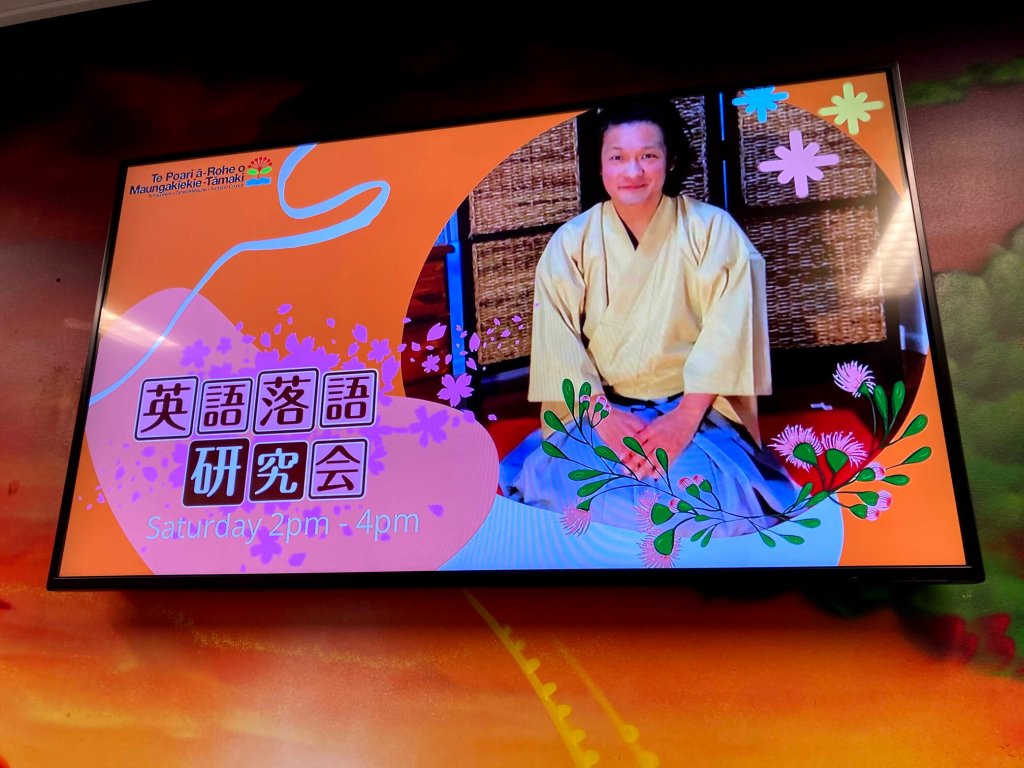
DATES: 2:00PM-4:00PM, every other Saturday: 14 Nov, 28 Nov, 12 Dec 2020
PLACE: Maungakiekie Room, Onehunga Community Centre (83 Church Street). You can come in from Church Street (library entrance) and go downstairs. It is the first room on the left.
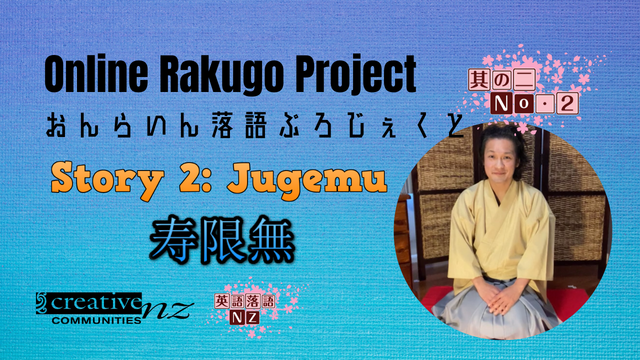
[The recording of this story is at the bottom of this post.]
Jugemu(寿限無) probably is one of the best-known rakugo stories in Japan along with Time Noodles (時そば) andScary Manju (まんじゅうこわい).
It is also one of my favourite stories to perform for people who are new to rakugo.
This tale is about this Japanese boy who had an unnecessarily long name, which would cause all sorts of problems. I am very glad that my name is NOT…
Jugemu jugemu Gokouno surikire Kaijari suigyono Suigyoumatsu unraimatsu furaimatsu Kuneru tokoroni sumutokoro Yaburakoujino burakouji Paipo paipo paipono shuringan Shuringan no gurindai Gurindai no ponpokopi no ponpokona no Chokyumei no chosuke
(*There are some different variations.)
The exact origin of this story is unclear as its basic structure appears in many books and folktales.
The prototype of this story is found in Shasekishu (沙石集) or “Sand and Pebbles”, which was a collection of Buddhist parables compiled by a monk called Muju (無住) in 1283.
It was widespread, and the same concept can be found in Kyogen and a traditional lullaby from Shinano Azumigouri Yamato Village (信濃安曇郡倭村).
One of the scary variations I have heard of before is that Jugemu drowns because his name was a bit too long…
Just like the original Grimms’ Fairy Tales, some stories became un-PC, so they have been rewritten over time as rakugo is not only a traditional art but a popular art at the same time.
(My Jugemu might be more appropriate to be called “New Zealand Jugemu”! 😁)
Hi all, how have you been? Hope everything’s well with you all!
So… our rakugo club has finally resumed its activities after a long break due to the Covid crisis and relocated ourselves in Onehunga!
We had 7 participants including myself, and we had the most memorable new beginning with two special guests, one with a smiley face and the other with a cat face.
If you have been following my blog, you might have guessed, but they are the “rakugo masters” whom I introduced here a while ago.
They came back!!!
In yukata (a casual summer kimono) and ready to perform!!!
This is how this dream gig took place.
The night before, their mother e-mailed me saying that their older daughter had just performed “Jugemu” in front of her class for the Culture Day at her school. She obviously taught herself the entire story and actually performed it!
This was literally the best thing that’s ever happened in my rakugo career!
I somehow inspired this little girl to love and even perform rakugo in public!
When they started coming to my shows, I initially thought it was just a temporary thing, but it’s been a few years now.
So… I told her mum that the rakugo club is resuming the next day.
She hadn’t known anything about it but e-mailed me at the most perfect timing!
The girls showed up, completely ready to perform, and…
WOW, the older girl performed Jugemu almost perfectly!!!
The little one also recited the name of Jugemu for us.
I couldn’t believe they taught themselves by watching rakugo on YouTube!!!
We were all mesmerised and inspired by their performances!!!
They are planning to come back to the club whenever they can 🙂
I am very excited about the future of rakugo in New Zealand!!!







 English Rakugo NZ