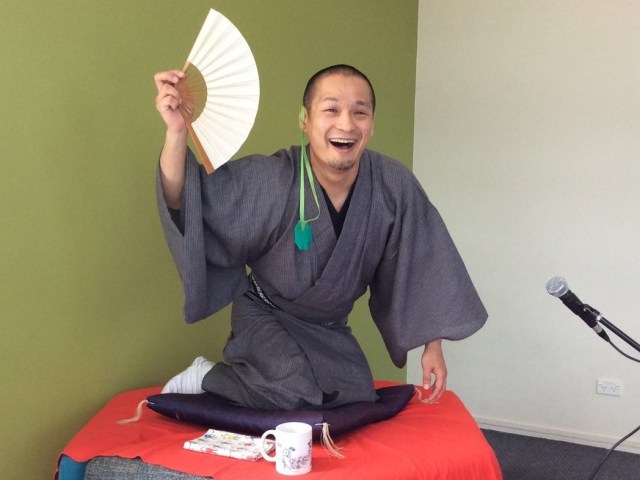
English Rakugo performer and actor based in NZ. A full-time rebel with common sense. A lover of art, books, comedy, Japanese culture/ language, music, peace, positivity, theatre, and trivia. Idealistic, but ain't no saint.
鹿鳴家英志(本名:中辻拓志)。ニュージーランドを拠点とする役者・英語落語パフォーマー。アメリカへの演劇留学をきっかけに、気付くと海外滞在20年。現在ニュージーランドに永住中。アメリカの4大卒業後は日本で英会話講師を経験、その後ニュージーランドの高校教師資格を取得する。ニュージーランドでは英語にてスタンダップコメディーを行い、2005年ニュージーランド国際コメディーフェスティバルの新人大会にて全国優勝を果たす。その後、テレビドラマ、CM等に出演、テレビのレポーターも勤める。
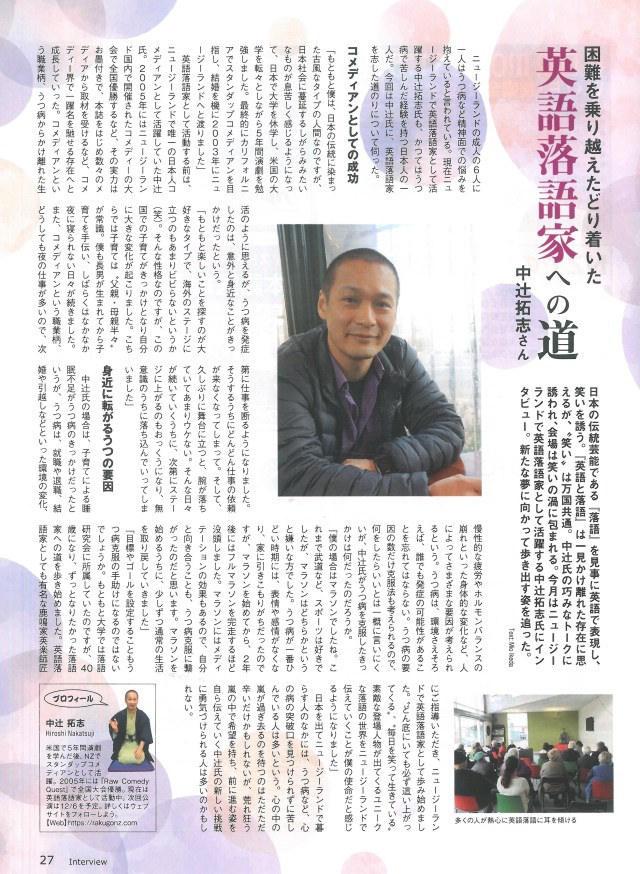
I have just received an interview for a New Zealand based Japanese magazine called “Gekkan NZ”. If you live in New Zealand, you can get a copy from a Japanese restaurant or a Japanese grocer like Japan Mart.
Sorry it’s all in Japanese and Google Translate doesn’t work as it’s jpg… well, it doesn’t work anyway 😉
“Shinuchi” (pronounced “Shin uchi”) is the master status in the Rakugo world i.e. the highest rank that a Rakugo performer can ever achieve. Only by achieving this status, you are allowed to perform as the headliner in a line-up show and take your own apprentice to preserve the Rakugo tradition.
It normally takes roughly 15 years of full time training to reach this status.
What makes this news even more exciting is that one of the five new Shinuchi this time round is a woman!
Rakugo was traditionally developed by men, and it wasn’t until 1993 that female Shinuchi were born. I used the plural form because in fact two female Shinuchi, Kokontei Kikuchiyo (古今亭菊千代) and Sanyutei Karuta (三遊亭 歌る多), were born in the same year!
And this month Kokontei Kikuchiyo’s apprentice Kokontei Komako (古今亭駒子) will become a Shinuchi, therefore becoming the first time ever female master-disciple both reaching the Shinuchi status in history.
Rakugo is evolving.
Incorporating more feminine elements into Rakugo will definitely transform this art form.
Exciting time we live in!
If you read Japanese, you can find more information on this page.
As it is a public domain work, I will copy the texts below as well:
Mosaku and his apprentice Minokichi journeyed to a forest, some little distance from their village. It was a bitterly cold night when they neared their destination, and saw in front of them a cold sweep of water. They desired to cross this river, but the ferryman had gone away, leaving his boat on the other side of the water, and as the weather was too inclement to admit of swimming across the river they were glad to take shelter in the ferryman’s little hut.
Mosaku fell asleep almost immediately he entered this humble but welcome shelter. Minokichi, however, lay awake for a long time listening to the cry of the wind and the hiss of the snow as it was blown against the door.
Minokichi at last fell asleep, to be soon awakened by a shower of snow falling across his face. He found that the door had been blown open, and that standing in the room was a fair woman in dazzlingly white garments. For a moment she stood thus; then she bent over Mosaku, her breath coming forth like white smoke. After bending thus over the old man for a minute or two she turned to Minokichi and hovered over him. He tried to cry out, for the breath of this woman was like a freezing blast of wind. She told him that she had intended to treat him as she had done the old man at his side, but forbore on account of his youth and beauty. Threatening Minokichi with instant death if he dared to mention to any one what he had seen, she suddenly vanished.
Then Minokichi called out to his beloved master: “Mosaku, Mosaku, wake! Something very terrible has happened!” But there was no reply. He touched the hand of his master in the dark, and found it was like a piece of ice. Mosaku was dead!
“I see reality in another way with a camera. Looking through the lens, I peer into another world… For me, the camera is simply an excuse to learn.”
“Photographic: The Life of Graciela Iturbide” by Isabel Quintero
I know I should really be writing about the “Rakugo& Tsugaru Shamisen” performance and my recent visit to a retirement home where I performed Rakugo for 90 year-old plus audience.
But I wanted to record this thought before I lose it.
The other day when I was browsing through a graphic novel about Graciela Iturbide, I stumbled upon the quote above.
I am not sure if it was an exact utterance by Iturbide, but it really explained why I have been pursuing Rakugo, very much a minority art, alone in New Zealand.
Allow me to heavily plagiarise…
it surely isn’t plagiarism as long as I mention the source, right?
The reason I do Rakugo is because…
I see reality in another way with Rakugo. Looking through the Rakugo stories, I peer into another world… For me, Rakugo is simply an excuse to learn.
Along with Hachigoro (八五郎), one of the best known stock characters in the Rakugo-verse is Kumagoro (熊五郎). He is usually referred as “Kuma-san” (熊さん) or simply “Kuma” (熊) , which means a bear.
As the name suggests, this “Edokko” (江戸っ子)* is quick tempered, not someone to mess with! He is usually a carpenter in Rakugo tales and loves drinking sake. He is almost an alcoholic and gets into trouble when he drinks a little too much.
He is not the smartest person in Rakugo, but he is immensely likeable, someone with a very big heart. He is one of my favorite characters as he reminds me a little bit of myself. No, I do not have drinking problems!
* “Edokko” or “Edoite” is the term for those who lived in “Edo”, the old name for Tokyo, which was used during the Edo Era (1603-1868). They were known for their hospitable yet feisty temperament. I actively promote these terms so that they will be recognized internationally someday!
In Rakugo, there are some stock characters that show up over and over in multiple stories. One of such Rakugo-verse dwellers is Hachigoro (八五郎). His nicknames are usually: “Hachi”,“Hats-an”* (八っつぁん), or “Garappachi”* (ガラッ八).
Hachi is a happy-go-lucky clown type. He is usually quite likeable but an infamous scatterbrain. He is a bigmouth and has a tendency to act on half-baked knowledge.
Wherever he goes, chaos ensues.
In one story, he ends up becoming a monk. In another, he gets promoted to be a samurai warrior. He is possibly the best known character in Rakugo along with Kumagoro (熊五郎) and Inkyo (隠居) (whom I will introduce in other articles!).
This man mainly appears in Edo Rakugo (Tokyo Rakugo) but barely gets a cameo appearance in Kamigata Rakugo (Osaka Rakugo).
* These spellings are for pronunciation purposes only.